Transforming water-intensive value chains with data and collaboration
Focusing on emissions reduction, soil restoration, and climate-resilience practices
Strengthening market access, farmer institutions, agri-finance, and digital innovation
Creating bio-based value chains and transforming waste into value
Improving inclusion as a social and commercial imperative
Use case 1: Water Numeracy for Farmers
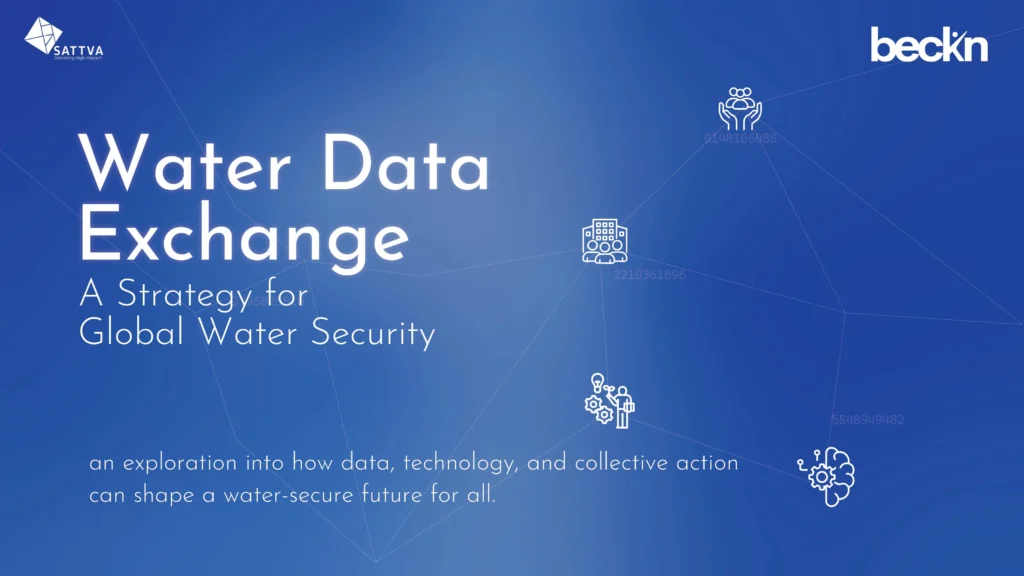
The Water Data Exchange (WDE), Sattva’s flagship project, proposes a decentralised Universal Digital Infrastructure (UDI) to democratise access to high-quality water data at scale. The 5-year ambition for WDE is to empower 20 million households with credible, accessible and actionable water data through 10 critical use cases across a minimum of 5 states in India.
Explore our vision paper to ensure a water-secure future for all
Water Numeracy for Farmers, one of the use cases under the Water Data Exchange, aims to leverage various real-time water data points for actionable crop planning and irrigation decisions for smallholder farmers across India. It empowers farmers to make data-driven irrigation decisions and builds long-term climate resilience through a collaborative, open-source ecosystem.
Transforming water-intensive value chains with data and collaboration
Focusing on emissions reduction, soil restoration, and climate-resilience practices
Strengthening market access, farmer institutions, agri-finance, and digital innovation
Creating bio-based value chains and transforming waste into value
Improving inclusion as a social and commercial imperative
What Will It Take To Revive India’s Almost Forgotten Grain
DCM Shriram Foundation, Sattva Knowledge Instititute moot ‘Water Index’ to address agri water crisis
50% of districts in India could face ‘severe’ water scarcity by 2050, says report
Can India withstand a water crisis?
What the Budget can prioritise for climate action in agriculture
As thirst for water grows, it’s time to harvest both water and data
How citizen science is revolutionizing water management in Indian agri
How India’s water crisis is also a data problem
A beverage giant with operations in Punjab and Maharashtra wanted to address regional water security issues. We assessed 30+ problem areas in both states. Punjab struggled with poor crop selection and production techniques, while Maharashtra faced droughts and information asymmetry amongst farmers.
We evaluated 120 interventions and devised 6 roadmaps for solutions:
We partnered with a sustainable agriculture organisation and a cotton programme to explore a scalable regenerative model in Telangana and Gujarat.
The study used mixed methods (secondary research and stakeholder interviews) to identify key indicators such as crop diversity, income patterns, gender roles, child labour prevalence, climate vulnerability, soil and water health, and existing sustainability practices.
The assessment enabled our partners to determine the most conducive conditions to set up the agri-model.
A leading pharmaceutical company based in India aims to improve farmer income through a climate-resilient and tech-enabled approach.
A range of our project interventions was adopted by the farming communities:
A global impact investment organisation keen on launching an initiative to nurture startups founded on decent work & circular economy principles, partnered with us to conduct an initial study of high-potential sectors, business models, and a voice-of-the-customer study.
The study helped our partner:
A worldwide beverage company onboarded us to conduct a study of its sustainable, gender-focused farming initiative.
Our study consisted of a literature review and primary research that covered ~400 households and ~100 women farmers. The final product enabled our client: