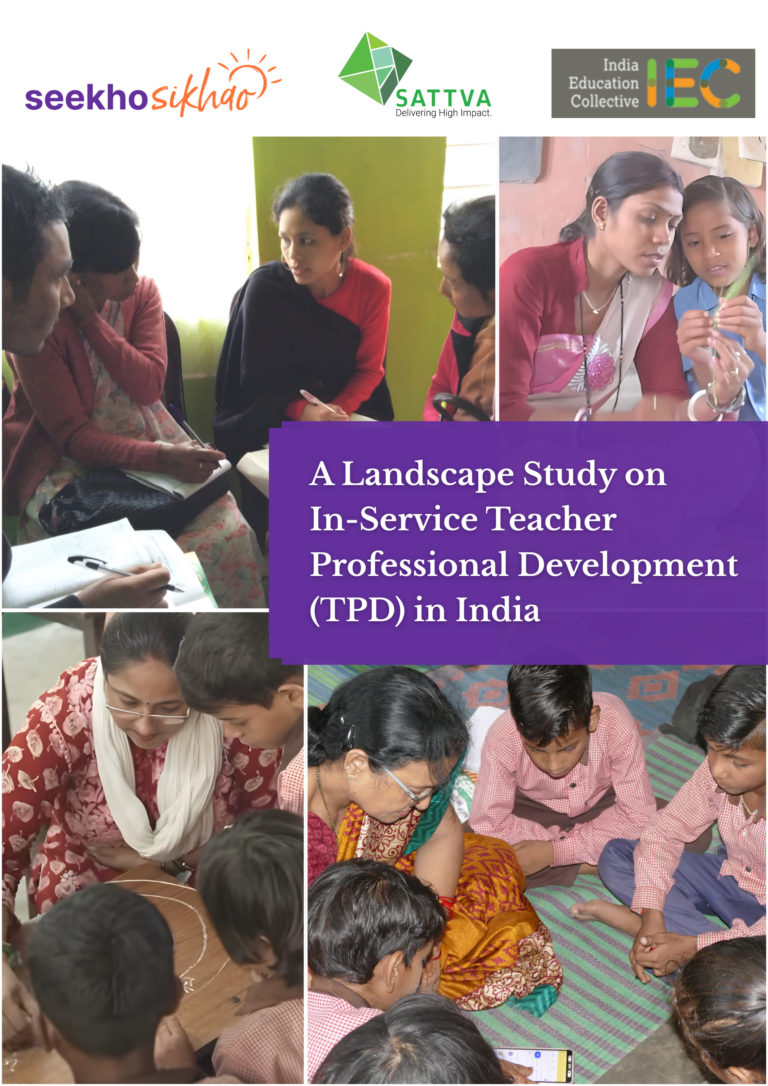

In India, 1 out of 12 girls gives up on her educational journey before completing secondary education. Globally, more than 130 million girls are out of school until 2020 as per the reports of World Bank and UNICEF. An adolescent girl in a low-income country is nearly twice as likely as a boy to never complete lower secondary education.
India has made significant progress in getting girls into school. Yet adolescence remains a critical point of attrition. In 2025-26, 8% of girls enrolled at the secondary level dropped out, compared with 3.4% at the upper-primary level and 0.1% at the primary level. The question, then, is no longer only about access. It is about what enables a girl to remain in education, navigate constraints, make decisions and turn educational opportunities into a meaningful pathway forward.
This is where social and emotional learning (SEL) becomes important, not as another programme added to the school calendar, but as a foundational layer of capability development. Download the latest report by Sattva, “Enabling Girls to Navigate Secondary Education and Work in India”
Adolescence is more than a transition between grades
The years between Grades 9 and 12 are a pivotal time. Girls are navigating changes in identity, relationships, confidence, decision-making and their understanding of what comes next. These capabilities influence how they respond to setbacks, negotiate constraints and make choices about education, skilling and work.
Yet interventions for adolescents have often been designed in the opposite direction: identify a framework, define a set of skills and then build programmes around them. This affects how SEL itself is understood.
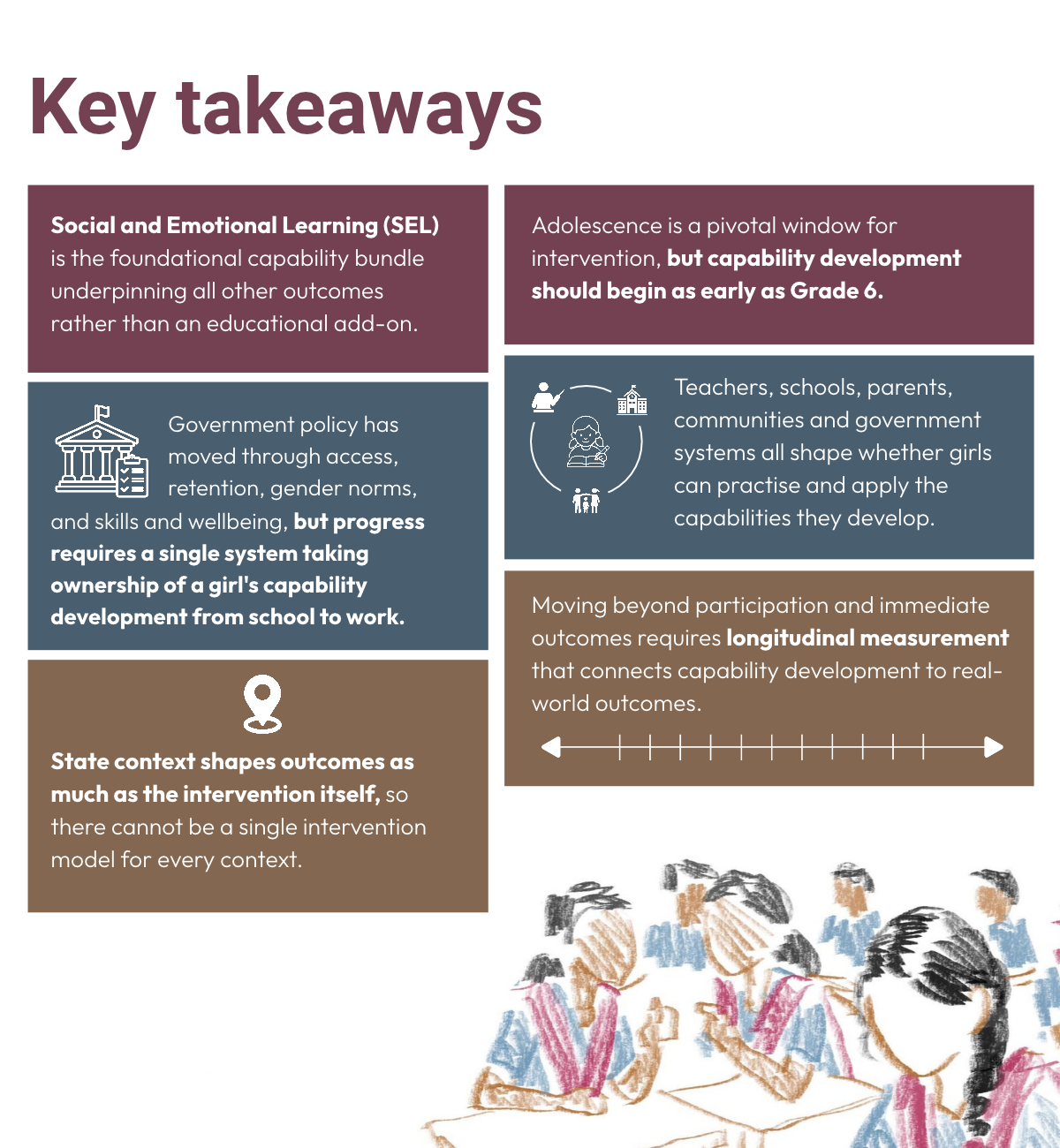
Development cannot begin only when a girl is approaching the end of secondary school, it requires a continuum beginning earlier in adolescence and developing through Grades 6 to 12.
The girl cannot be the only point of intervention
A girl may learn decision-making in a programme, but her ability to exercise agency depends on what happens beyond that session, in the classroom, at home, in her community and eventually in the workplace.Hence, building capability transcends teaching girls the right skills, it is about sustaining an environment where these skills are practiced and enforced.
Many SEL interventions remain modular or school-based, while teachers, parents, communities and government systems are not always positioned as active parts.
Comparison of adolescent girls’ education in states like Jharkhand, Rajasthan, Madhya Pradesh and Maharashtra illustrates why there cannot be a single intervention model for every context. The challenges range from mobility and gender norms to weak school-to-work pathways, mental health concerns and gaps between innovation and system-level adoption.
The opportunity, therefore, is to strengthen the ecosystem around the girl so that capability development becomes part of everyday learning and decision-making.
Are we measuring what actually changes?
Even after building capabilities and providing the right environment, there is another problem: knowing whether an SEL intervention worked.
India has adopted several global tools, such as the Strengths and Difficulties Questionnaire and the Rosenberg Self-Esteem Scale, and has started building its own, including NCERT’s School Health and Wellness Programme assessment framework and CBSE’s Health and Physical Education assessment. But most of this measurement stops at participation and awareness, rarely tracking whether a girl’s decision-making ability or resilience actually changed, or held up months after the programme ended.
A more useful question is whether capabilities persist and influence outcomes over time.
The report calls for longitudinal measurement, linking capability development to outcomes such as educational continuation and completion, career aspirations and decision-making, participation in skilling, entry into employment, and retention and progression in the workforce. It also argues for combining structured assessments with qualitative methods and classroom observation rather than relying only on self-reported responses.
This shifts the focus from asking Did the programme reach the girl? to asking Did it change what she is able to do? Download the report.
From education access to economic mobility
The larger opportunity is to stop treating SEL as an end in itself. For adolescent girls, capabilities matter because they can shape whether educational opportunities become sustained participation, whether aspirations become decisions, and whether education eventually translates into economic mobility.
That requires starting earlier, building capabilities through practice, strengthening the ecosystems around girls and measuring what happens beyond the programme cycle. Because capabilities are not built through a single session or module, they develop through repeated practice in the environments where girls actually live and learn.
Why is education important for girls in India?
Education is the starting point for a girl's long-term economic and social independence, but access alone hasn't closed the gap. Despite rising school enrolment, female labour force participation in India stands at just 41.7% (PLFS 2023-24), showing that education is not consistently translating into workforce outcomes. Closing this gap requires pairing education with the socio-emotional capabilities girls need to convert schooling into sustained participation in work and society.
What is social emotional learning (SEL)?
Social emotional learning (SEL) refers to the capacities that help individuals understand and manage emotions, build relationships, and make responsible decisions. For adolescent girls in India, SEL is treated as a foundational capability bundle rather than a standalone subject, one that underpins mental wellbeing, educational persistence, and future employability.
What does the CASEL SEL framework cover?
The CASEL framework is one of the most widely referenced global models for organising SEL into five competencies: self-awareness, self-management, social awareness, relationship skills, and responsible decision-making. Across more than 20 global and Indian frameworks, including CASEL and the Harvard EASEL Lab database, these same underlying skills consistently appear, even when programmes label them differently, such as life skills, wellbeing, or 21st-century skills.
What are the barriers to girls' education in India?
Barriers to girls' education in India go beyond access to schools. They include entrenched gender norms, restrictions on mobility and decision-making, early marriage pressure, and a lack of school-embedded support for emotional regulation and decision-making during adolescence. Policy fragmentation across education, health, and skilling systems also means girls' developmental needs are addressed in silos rather than as a continuous pathway from school to work.
How does adolescent development affect girls' mental health and resilience?
During adolescence, the prefrontal cortex, which governs impulse control and decision-making, matures more slowly than the limbic system, which drives emotion and reward-seeking. This mismatch makes adolescent girls more sensitive to stress, peer pressure, and social evaluation, and without adequate support, it can result in lower self-esteem, difficulty coping with setbacks, and increased vulnerability to anxiety and depression.