From rainfall extremes to groundwater collapse, India’s water crisis has moved from a seasonal worry to a structural threat. The prospect of a 2026 super El Niño adds another layer of uncertainty, with concerns around rainfall deficits, urban water rationing and agricultural drought, placing sustained pressure on both city supply networks and farm output. Rainfall is more unevenly distributed than most businesses realise, and the groundwater that entire regions rely on is running out faster than it can be replenished. Under the National Water Policy 2012, industry sits lowest in the government’s allocation priority and will be the first to face cuts, a risk tied to a potential 40–50 basis point hit to industrial production growth.
For any business operating in, or sourcing from, water-stressed parts of India, the question is no longer whether water scarcity matters. It is how directly and how soon it will affect operations, supply chains and growth.

Key takeaways
- 1,367 m³ is India’s annual per capita water availability, sitting well below the global stress threshold and confirming the crisis is structural, not seasonal.
- 26% of India’s administrative blocks now extract groundwater faster than it recharges, directly overlapping with regions growing the most water-intensive crops.
- Over 81% of rural households had tap water coverage under the Jal Jeevan Mission by mid-2026, real progress that remains at risk without matching wastewater treatment.
- 70 to 100 domestic agri-water startups are already active in India, giving corporates a ready pipeline of provable, scalable technology to invest in and de-risk.
- Watershed and decentralised wastewater interventions carry high technical maturity at low to medium cost, making them some of the most immediately actionable levers corporate India has to invest upstream.
- For businesses, the greatest opportunity may lie upstream—in the rural and agricultural catchments that support both supply chains and regional water security.
Sattva’s latest report, The Business Case for Water: Why Corporate India Must Invest Upstream, examines why corporate India must move beyond viewing water as a philanthropic cause and treat it as a business imperative. The scale of the underlying crisis, and why it demands upstream investment, is worth understanding in full. Download the report.
What is the water scarcity situation in India in 2026?
India’s core water crisis is driven by ever-increasing demand from population growth, urbanisation and economic expansion, set against a fixed and finite supply that climate shocks are making less predictable. The crisis threatens agricultural productivity, industrial operations and supply chain resilience. India’s annual per capita water availability stands at 1,367 m³, well below the global stress threshold.
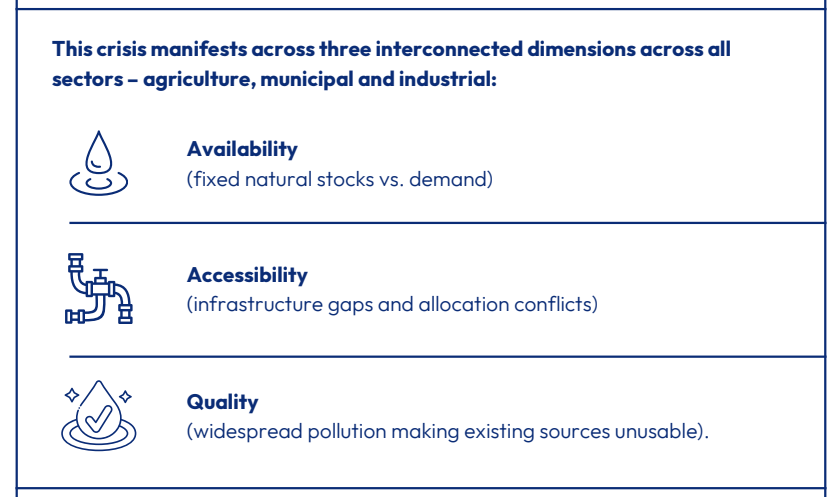
The multiple fault lines of India’s water crisis begin with a highly unequal rainfall pattern: 75% of it arrives in a single monsoon window between June and September. That leaves much of the country reliant on stored and underground reserves for the remaining months.
The problem also raises another question: is the available water safe and accessible? Contamination has turned a supply challenge into a public health emergency. Arsenic, fluoride and nitrate contamination affects groundwater sources that millions of households and farms depend on daily. But has treatment infrastructure kept pace with demand?
Download the report to understand the present condition of water in India.
Water accessibility is a separate, persistent challenge. Cities lose 38% of their water to distribution leaks. Poor maintenance of canal infrastructure, combined with fragmented farm landholdings, limits how effectively surface water reaches agricultural land. This seasonal and uneven supply is precisely why India has become so dependent on groundwater. It is the country’s default lifeline.
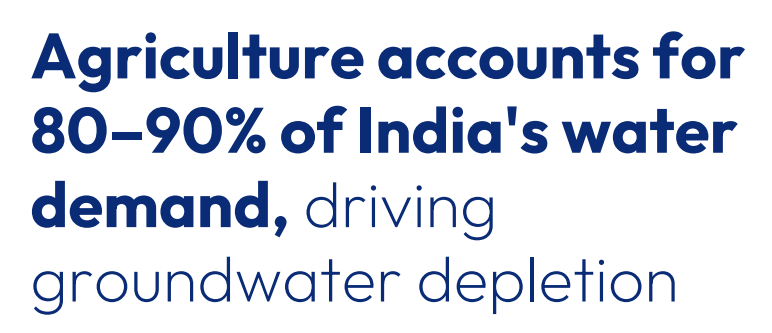
If groundwater collapse, agricultural demand and urban-driven depletion all threaten industrial water supply, yes, your business is at risk. The logical response is not to manage risk only within the factory gate but to invest in the rural-agri catchments that sit upstream of it.
Why is rural water health a business risk?
Agriculture supports over half of India’s population and employs close to half of its workforce, yet 90% of farmers hold under 2 hectares of land. These smallholders manage the very catchments that industrial and urban water security depends on, with limited capacity to invest in that resilience alone. Because regional watersheds are interconnected, a company’s water security is only ever as strong as the rural water health around it, which is why leading organisations are beginning to treat this investment as risk mitigation rather than philanthropy.
Government policy has shifted to protect India’s water future. Schemes such as Atal Bhujal Yojana (groundwater recharge), Jal Shakti Abhiyan (rainwater harvesting), Pradhan Mantri Krishi Sinchai Yojana (micro-irrigation) and Jal Jeevan Mission (drinking water access) now target this directly. Regulation is tightening too, with mandatory Zero Liquid Discharge and ESG disclosure requirements.
What are the six strategic pillars for upstream water investment?
Sattva’s report examines what different water interventions can look like, how technology and data can enable them, and how ready different solutions are for scale.
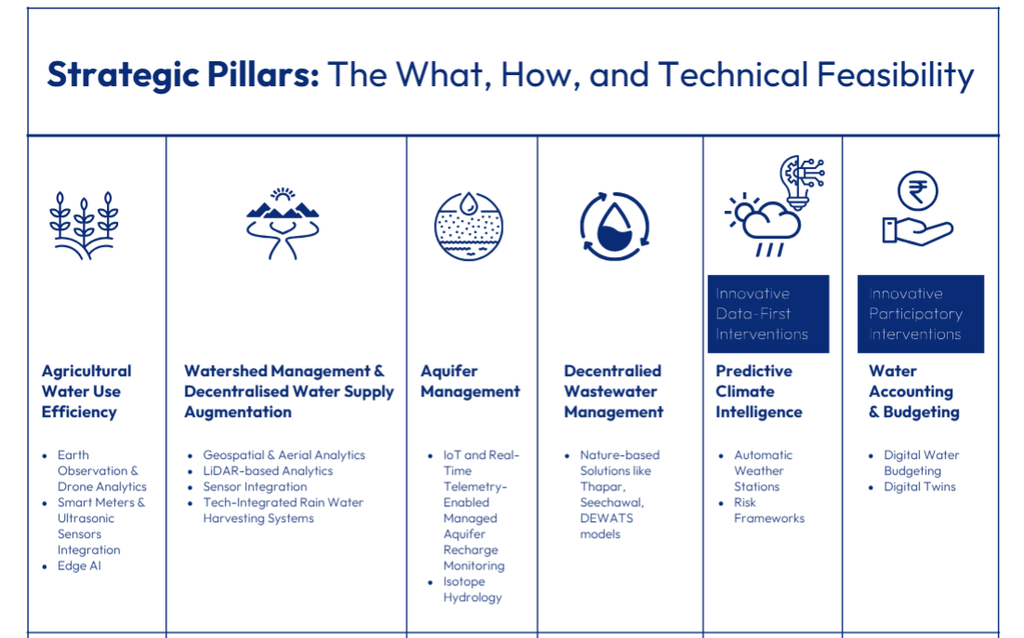
The framework spans agricultural water use efficiency, watershed management and decentralised water supply augmentation, aquifer management, decentralised wastewater management, predictive climate intelligence, data-first interventions and participatory approaches. Across these areas, solutions range from smart irrigation, sensors and earth observation to geospatial analytics, managed aquifer recharge monitoring, decentralised wastewater treatment and nature-based solutions.
Technology and data also open up new ways to anticipate and manage water risk, through automatic weather stations, hyper-local climate intelligence, predictive value-chain vulnerability mapping, digital water budgeting, water accounting and scenario planning. Alongside these, participatory approaches recognise the role of community governance in strengthening local ownership and the long-term management of shared water resources.
Learn in depth about the strategic pillars that underpin these interventions. Download the report.
A three-way scaling model for funders, government, and communities
The scale of the opportunity extends beyond any single actor’s own footprint. Corporations have capital but lack the institutional reach to scale nationally on their own. What they can do is fund and de-risk early-stage technologies, absorbing risk that government and smallholder farmers cannot. The government has reach but is typically risk-averse about funding unproven pilots. Government then scales proven interventions nationally through existing programmes, including Atal Bhujal Yojana, Jal Shakti Abhiyan etc… Civil society sustains these assets long-term, mobilising community structures such as Pani Panchayats and Farmer Producer Organisations.
India’s water crisis in 2026 is structural, and industrial water security cannot be secured through isolated corporate water projects. Only a blended approach by corporations, government and civil society could transform isolated corporate initiatives into a national, multi-stakeholder ecosystem that shifts India to a climate-resilient water economy.
Download the full report, The Business Case for Water, to explore the data, the strategic pillars and the partnership models that corporate India can use to invest upstream.