

A global tech company’s Global Capability Centre (GCC) in India ran 16 projects with 14 nonprofit partners across 11 states within the span of a year. It reached more than 20,500 students and teachers and 1,900 young adults, across STEM education, skilling, environment and community development.
What set the initiative apart was not the scale, it was the understanding that digital access is no more the finish line for CSR in Indian schools. Today, traditional digital literacy is the entry point. The conversation has expanded beyond digital access to preparing underserved communities for AI readiness, coding, computational thinking, STEM pathways and employability.
It is one example of where India’s Global Capability Centres (GCCs) are thinking about social responsibility as a long-term investment that could bring about systemic change. India is home to more than half of the world’s GCCs, and it sits on an opportunity hiding in plain sight for India’s social impact ecosystem.
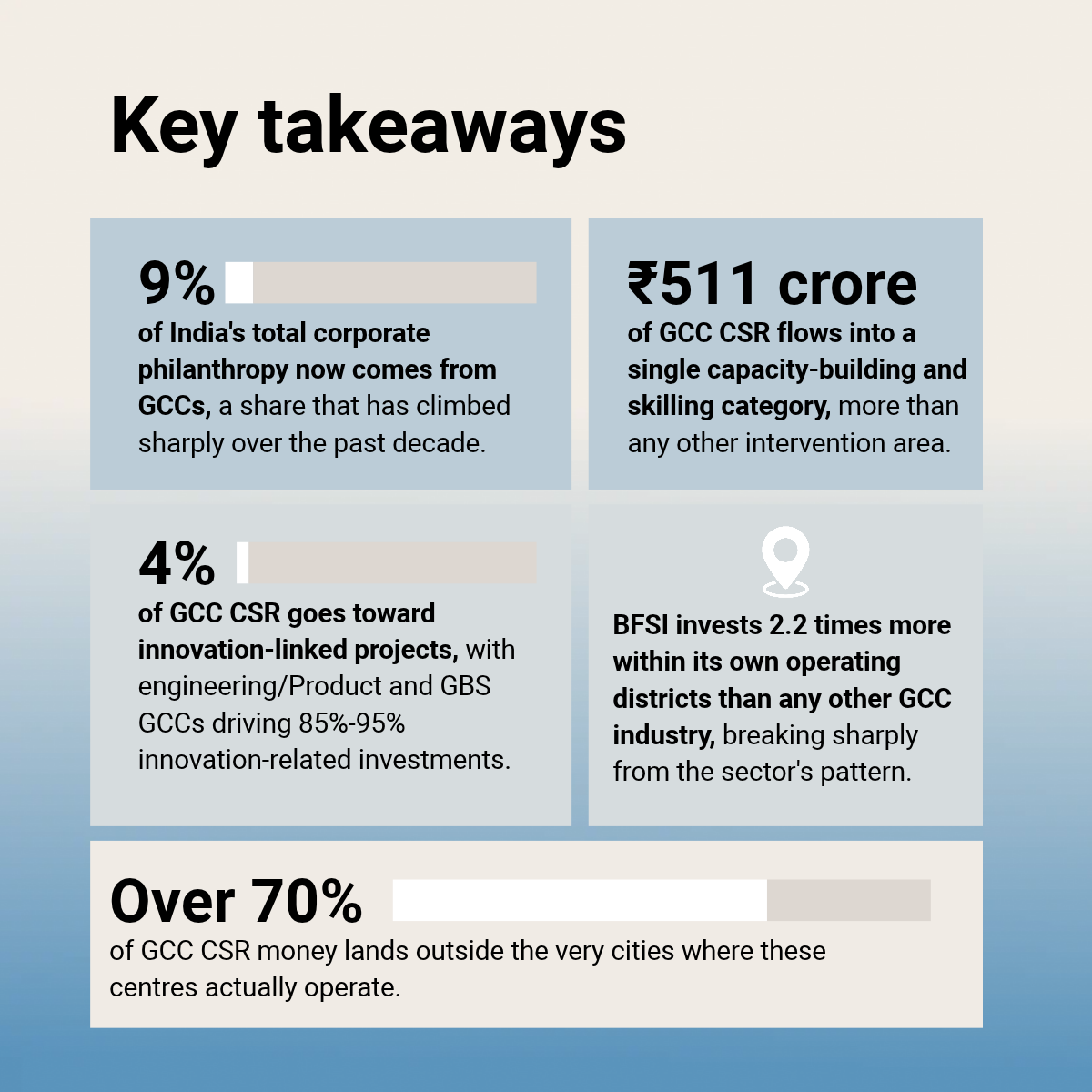
Key takeaways
- 9% of India’s total corporate philanthropy now comes from GCCs, a share that has climbed sharply over the past decade.
- ₹511 crore of GCC CSR flows into a single capacity-building and skilling category, more than any other intervention area.
- 4% of GCC CSR goes toward innovation-linked projects, with engineering/Product and GBS GCCs driving 85%-95% innovation-related investments.
- BFSI invests 2.2 times more within its own operating districts than any other GCC industry, breaking sharply from the sector’s pattern.
- Over 70% of GCC CSR money lands outside the very cities where these centres actually operate.
Sattva Consulting and India Data Insights have analysed data from the past decade in a new report, ₹3,661 crore CSR spending is only the beginning, an exploratory analysis of GCC CSR in India from FY15 to FY25.
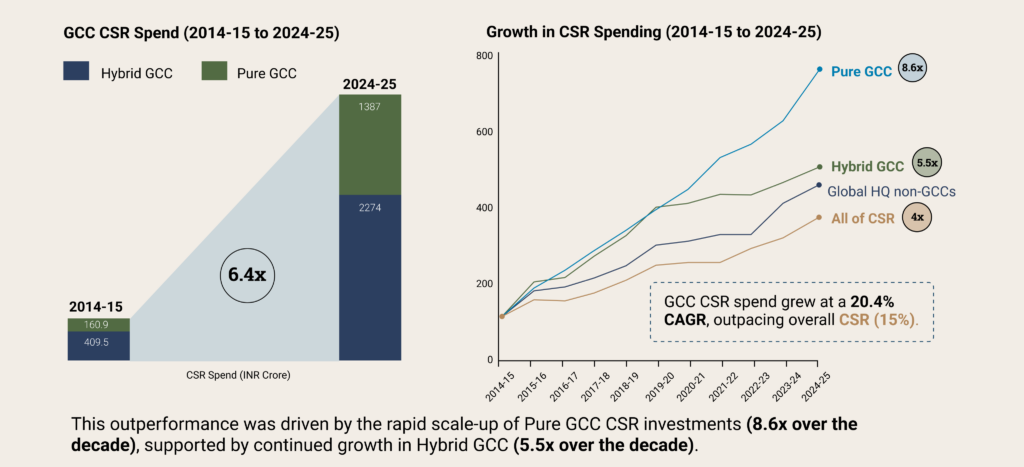
GCC CSR has grown over six times in the past decade to claim 9% of India’s corporate philanthropy, outpacing overall CSR growth, driven largely by a surge in Pure GCC contributions alongside steady growth from Hybrid GCCs.
A Pure GCC is an operational model where the parent company entirely owns, builds and manages the centre from the ground up. A Hybrid GCC, on the other hand, is a collaborative model that blends in-house corporate control with third-party vendor support. When splitting the ~₹24,388 crore universe of the last decade, Hybrid GCCs (556 companies) accounted for 61% while Pure GCCs (350 companies) contributed 39%.
A large share of GCCs in India are not Indian-headquartered, yet they are subject to the same 2% mandate as any Indian company once they cross the applicable thresholds. In recent years it is seen that the organisations are increasingly moving beyond the statutory mandate to address India’s priorities.
Over the decade, GCC CSR spend grew at a 20.4% CAGR, against 15% for overall CSR, evolving from an easily-overlooked slice of the pie into what the report calls a strategically significant contributor. Most of that acceleration traces back to Pure GCCs, whose CSR investments scaled 8.6 times over the same period.
Curious whether your sector is one of the fastest movers in this shift? The industry-level breakdown in the full report is worth a look. Download the report!
What are GCCs funding, and does the model change the choice?
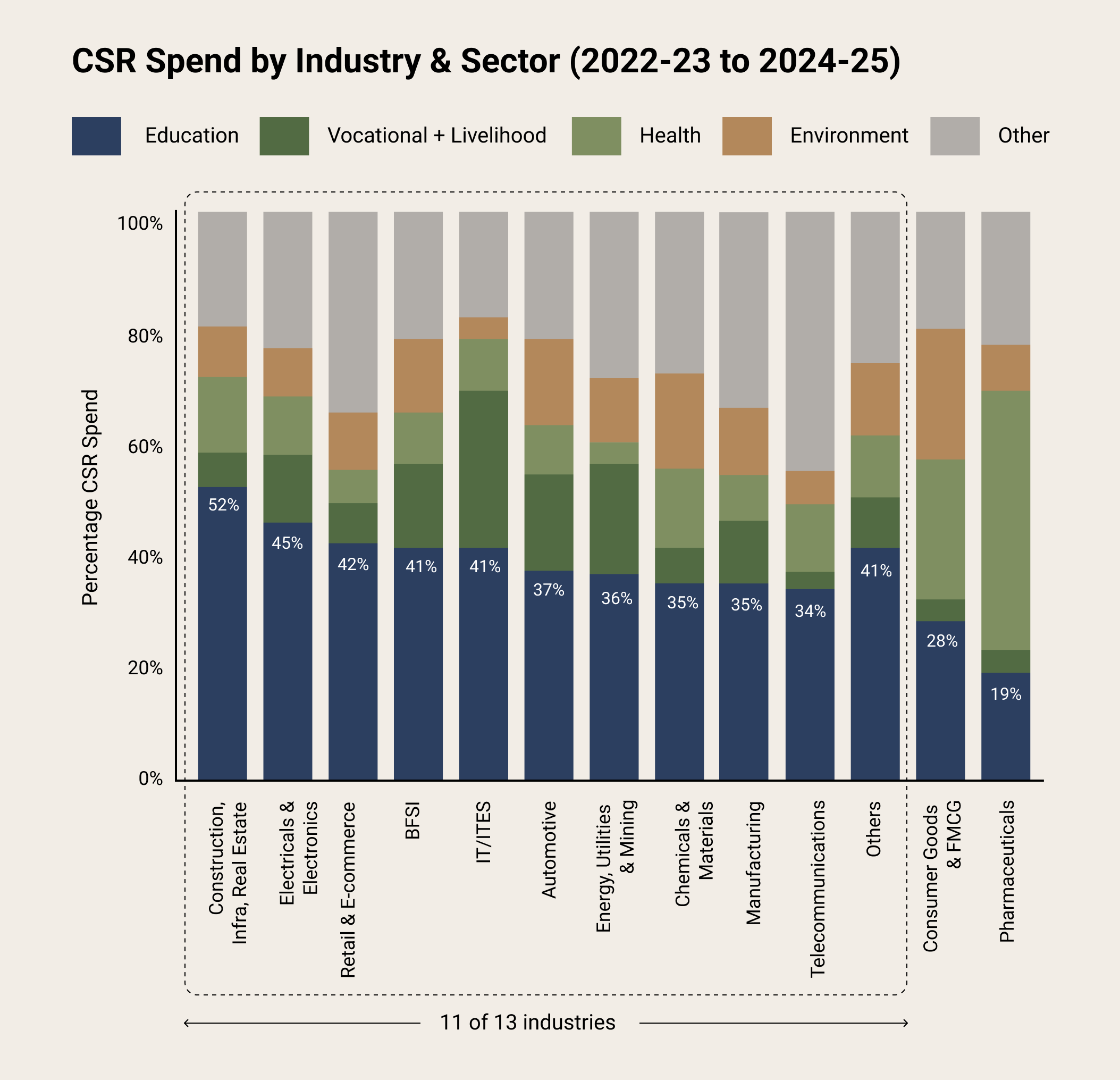
Ask what corporate CSR in India majorly funds, and two words surface almost immediately: education and healthcare. GCCs mirror that at first glance but the resemblance stops being convenient once the model is taken into account.
Pure GCCs follow this well-worn path closely. Hybrid GCCs, which carry a commercial or client-facing mandate alongside their capability-centre role, lean harder into livelihoods and vocational skilling. It is a quiet difference, but a telling one. It suggests Hybrid GCCs see their CSR mandate a little differently, shaped by the communities they are commercially embedded in, not just the ones their parent company chooses.
Innovation is where the pattern breaks more sharply. GCCs carry some of the deepest engineering and technical talent operating in India, and a portion of that expertise is already being channelled into their CSR, ₹435 crore has gone toward innovation-linked projects, concentrated almost entirely within Engineering/Product and Global Business Services centres. But set against the scale of capability sitting inside these centres, that comes to just 4% of total GCC CSR, an area that clearly warrants sharper focus going forward.
GCC CSR still favours Tier-1 India. Should it?
A GCC’s most valuable asset in a city is rarely capital alone. It is what accumulates over years of being present there: relationships with local colleges, a working understanding of the talent pipeline, and a genuine read on community needs. That kind of local knowledge is difficult to acquire from a distance.
Over 65% of GCC CSR remains concentrated within Tier-1 cities, with Pure GCCs even more so, directing 77% of their CSR into Tier-1 locations against 59% for Hybrid GCCs. Read differently, this concentration puts GCCs in a strong position to turn that accumulated local knowledge into real solutions for the urban challenges these very cities face, from infrastructure gaps to civic services under strain.
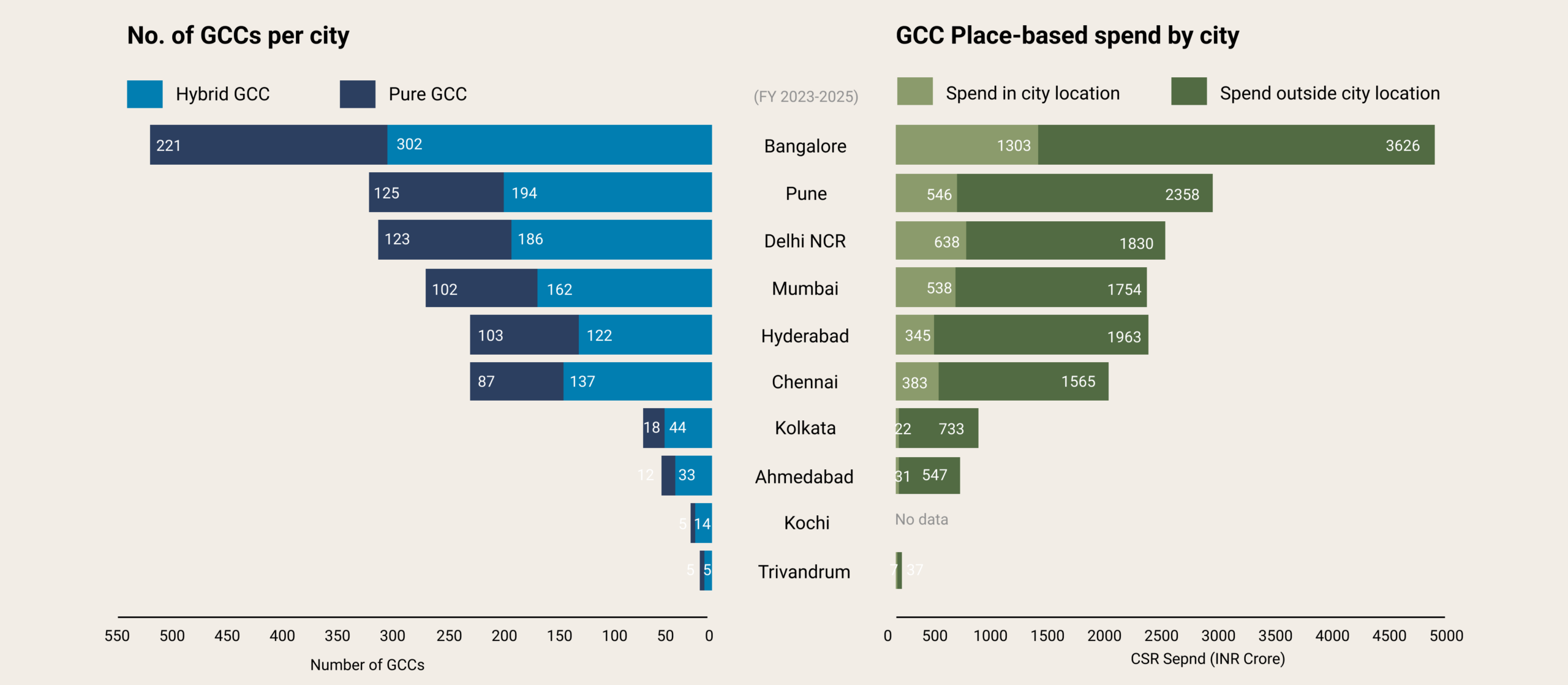
This concentration matters because it is about to be tested. As government policy pushes GCC expansion into new corridors beyond India’s established hubs, the extent to which CSR follows will determine how much of that expansion reaches the communities it is meant to serve. And geography is only one piece of what GCCs bring to this decision. Location determines where their contribution could land. What they actually hold, in capability, talent and expertise, determines how much that contribution could be worth once it does.
What comes next for GCC CSR in India?
GCCs already hold the talent, technical depth, and global experience to move learnings from elsewhere into local solutions, yet innovation remains among the smallest categories of GCC CSR spend today. Closing that gap could position India’s GCCs as genuine contributors to a knowledge-driven economy, not just its workforce.
With deep operational footprints already in place across India’s major urban centres, GCCs are positioned to contribute to urban development through technical solutions and collective action. Additionally, GCCs bring first-hand expertise in AI, automation and new operating models that reshape what employability looks like. Channelling these privileges into how India prepares itself could be one of the more consequential uses of GCC CSR in the years ahead.
GCCs’ technology, talent and capabilities could unlock far greater impact for India’s development. That is the shift Sattva and India Data Insights lay out across the report, alongside the full decade of data behind it.
What is a GCC (Global Capability Centre)?
A GCC is a centre that a foreign-headquartered company sets up in another country to serve its own operations, ranging from engineering and technology to finance and business services. India hosts more than half of the world's GCCs, making it the largest hub for this model globally.
What is the difference between a Pure GCC and a Hybrid GCC?
A Pure GCC exists solely to serve its parent company, with no external clients or revenue. A Hybrid GCC serves the parent while also generating its own revenue, through products, services or local manufacturing. The distinction shapes how each model approaches CSR, from funding priorities to where the money is spent.
Are foreign companies required to spend on CSR in India?
Yes. Under Section 135 of the Companies Act, 2013, CSR obligations apply to any company meeting the specified net worth, turnover or profit thresholds, including Indian subsidiaries of foreign companies. Once the thresholds are crossed, the company must spend at least 2% of its average net profits on CSR activities.
How much do India's GCCs spend on CSR?
According to Sattva’s latest report, GCC CSR spend crossed ₹3,661 crore in FY25, now accounting for roughly 9% of India's total corporate philanthropy, a share that has grown sharply over the past decade.
Which Indian cities have the highest concentration of GCCs?
Bengaluru, Pune, Delhi NCR, Hyderabad and Mumbai host the majority of India's GCCs. Interestingly, CSR spending doesn't fully track this footprint, a large share of GCC CSR money is deployed outside these operating cities altogether.