
India is ranked 9th on the Climate Risk Index 2026 and has been handed a $10 trillion price tag for the climate transition envisioned under Net Zero 2070 and Viksit Bharat 2047 goals. This is a small fraction of the estimated $2.5 trillion India needs to meet its Nationally Determined Contributions by 2030. Sattva Consulting and India Data Insights (IDI) traced a decade of environmental CSR disclosures filed with the Ministry of Corporate Affairs to track where this money has gone, who is spending it, and how well it tracks India’s actual climate risk. Read the full analysis in our report: A Decade of Green Spending: What ₹17,000 crores of environmental CSR reveals about corporate India; here is what it found.
A decade of green spending: What ₹17,000 crores of environmental CSR reveals about corporate India
Read the full report by Sattva Consulting & India Data Insights · July 2026
How much has corporate India spent on environmental CSR in a decade?
India allocates less than 10% of its CSR spending to the environment, despite ranking 176 out of 177 countries on the Environmental Performance Index (EPI) 2026. Environmental CSR spending currently stands at ₹17,377 crore, a long way from the estimated $2.5 trillion India needs to meet its Nationally Determined Contributions by 2030. Allocations are set to grow alongside rising climate risk and ESG expectations, it is worth examining how the current spend is actually distributed.
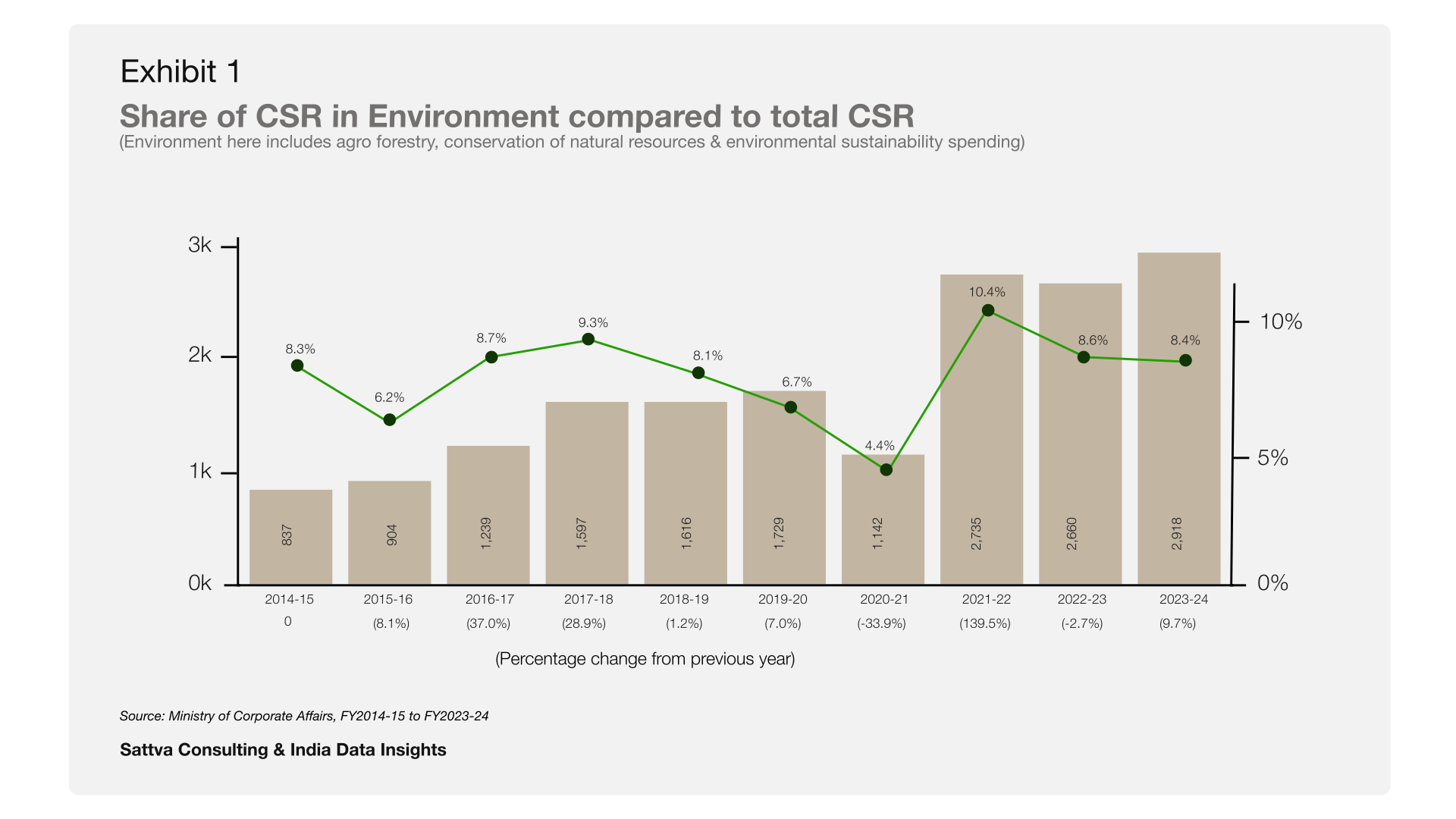
Sattva’s analysis shows that the recent growth in environmental CSR signals a clear shift in corporate priorities, with climate and resilience emerging as a prominent focus area. But its reach into systemic, long-term interventions, and into India’s most geographically vulnerable regions, warrants closer scrutiny. Is the sector growing in the right direction, or simply growing?
Who is funding environmental CSR?
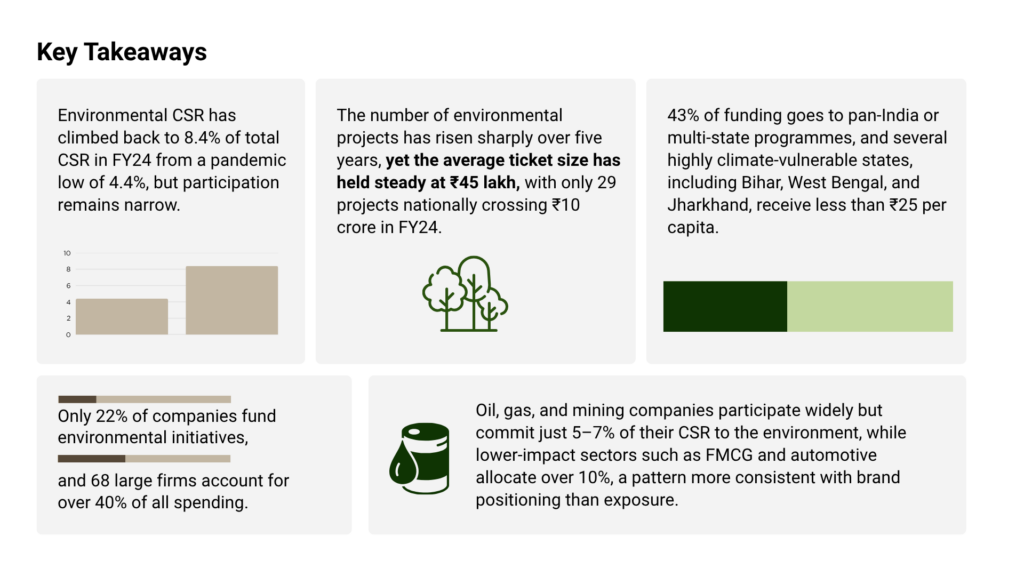
Only 22% of all companies direct their CSR towards environment-focused initiatives, and participation increases sharply with budget size. As a result, environmental CSR in India is anchored by a relatively small group of large contributors.
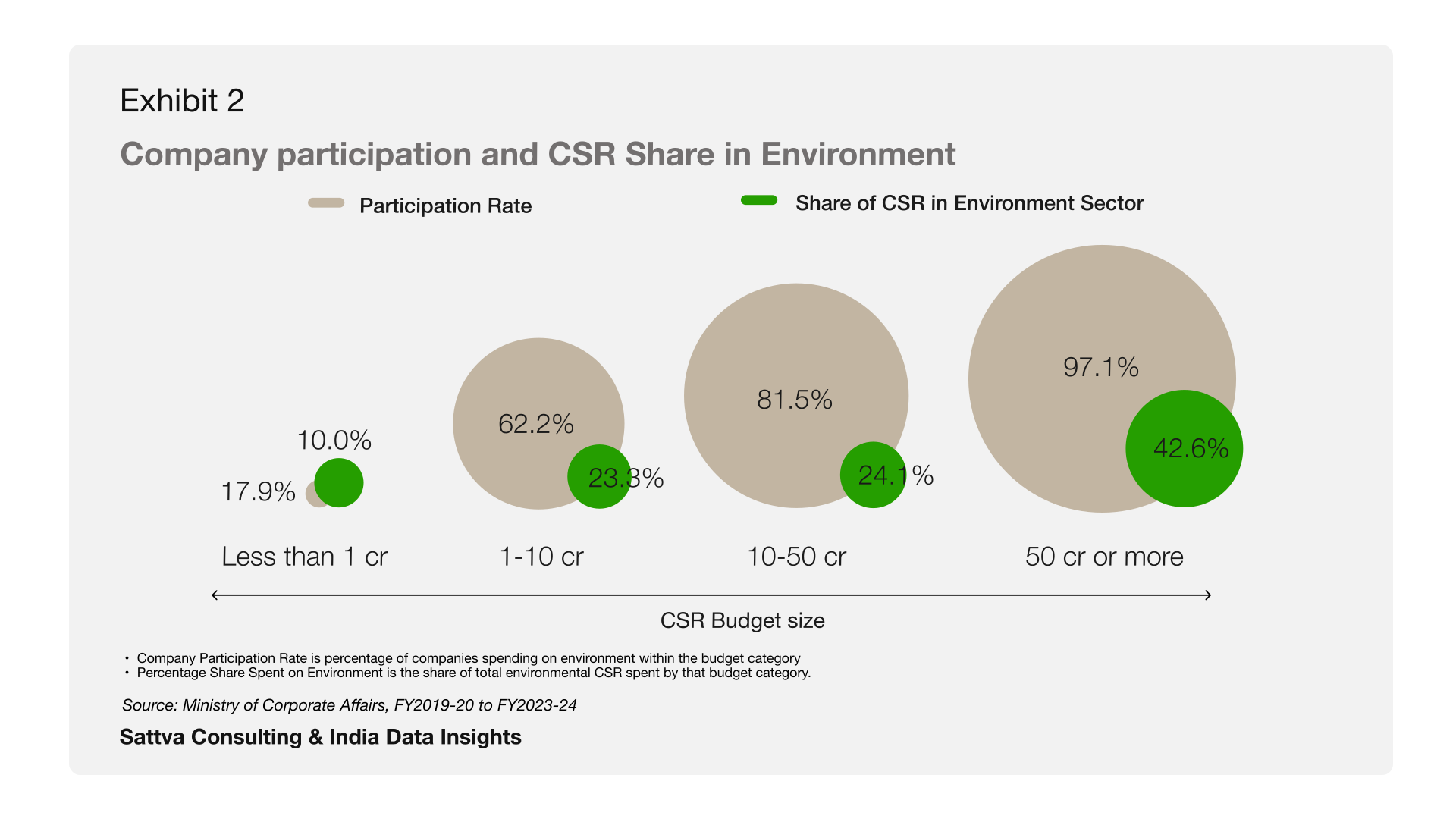
Ownership structure and regulatory exposure shape this participation considerably. Among the largest companies driving environmental CSR spending, European-headquartered MNCs show higher participation than Indian firms, a disparity that likely reflects the more stringent and consistently enforced regulatory frameworks in Europe. As policies such as the Carbon Border Adjustment Mechanism come into force, Indian arms of these global companies will also be pushed towards similar standards.
While large contributors continue to drive the numbers, smaller and medium-sized companies are showing incremental support, with the environment featuring more prominently in their portfolios. That opens a real opportunity to expand and streamline India’s overall environmental contribution at scale. If a handful of large firms already lead the way, what would it take to bring the rest of corporate India along?
Is environmental CSR growth about bigger projects, or more of them?
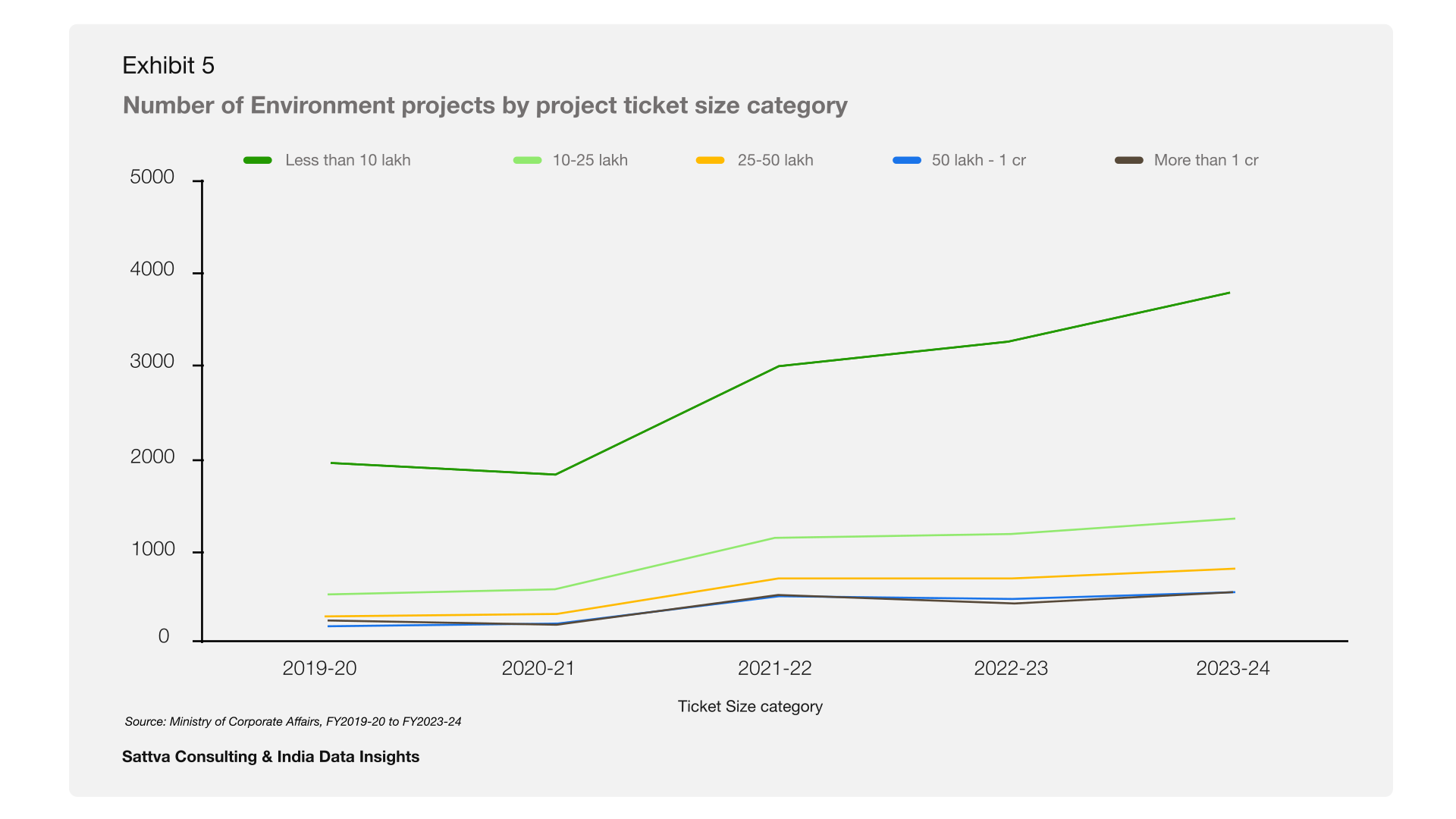
The resurgence in environmental CSR funding after the COVID-19 pandemic has been supported by strong policy and market tailwinds, from renewable energy and EV adoption to growing demand for water efficiency, climate-resilient agriculture, and disaster preparedness, all of which create clear entry points for CSR to engage. CSR has an opportunity to play a more central role in advancing climate resilience and sustainable resource management. But the current expansion is being driven more by a rise in project participation than by a corresponding shift towards large-scale capital deployment.
Environmental CSR continues to be characterised by small and medium, multi-location investments rather than large-scale, systemic interventions, with the average project sized at ₹45 lakh. Only 29 projects in FY24 had budgets of ₹10 crore or more, a modest rise from 22 projects in FY20. Is a rising project count enough on its own, or does closing India’s environmental gap call for fewer, bigger bets?
Industry participation doesn’t track environmental footprint
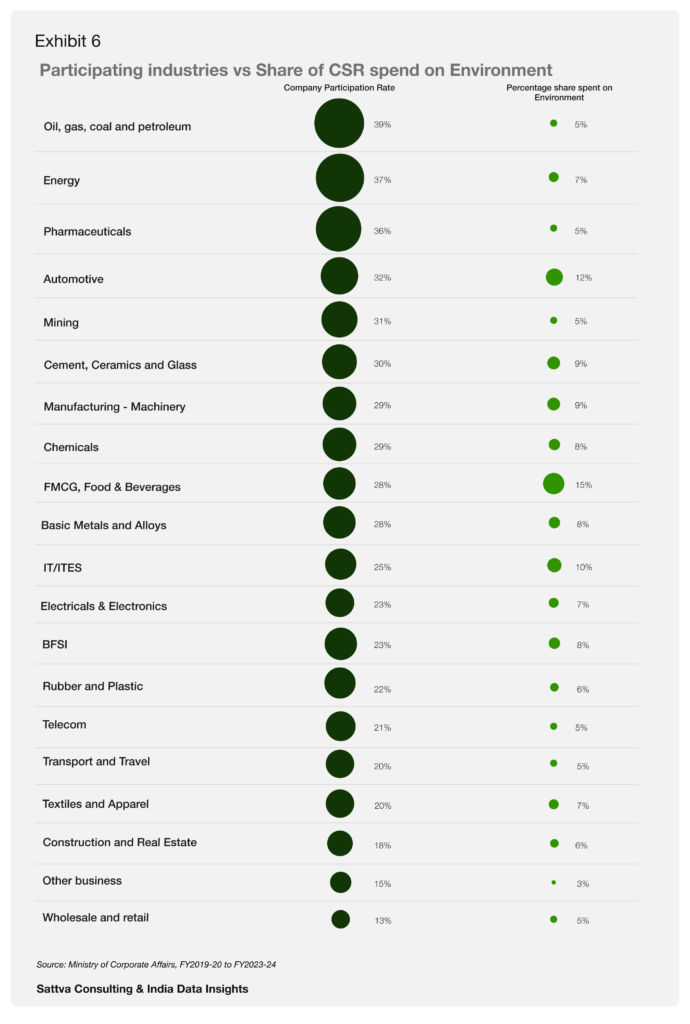
While environmental CSR participation is influenced by industry exposure, CSR spend does not yet consistently align with the intensity of environmental footprint. Sectors with large environmental footprints are not always the biggest environmental CSR spenders. Some consumer-facing industries, with comparatively lighter direct impact, allocate more.
High-value environmental CSR initiatives in FY24 show a clear concentration in a few themes: water management, renewable energy, and biodiversity. These preferences vary by industry exposure. Sectors with a high pollution index tend to focus on restorative interventions, such as disaster relief and waterbody restoration, while medium-intensity sectors gravitate towards sustainable agriculture and renewable energy, with afforestation as a common thread between the two.
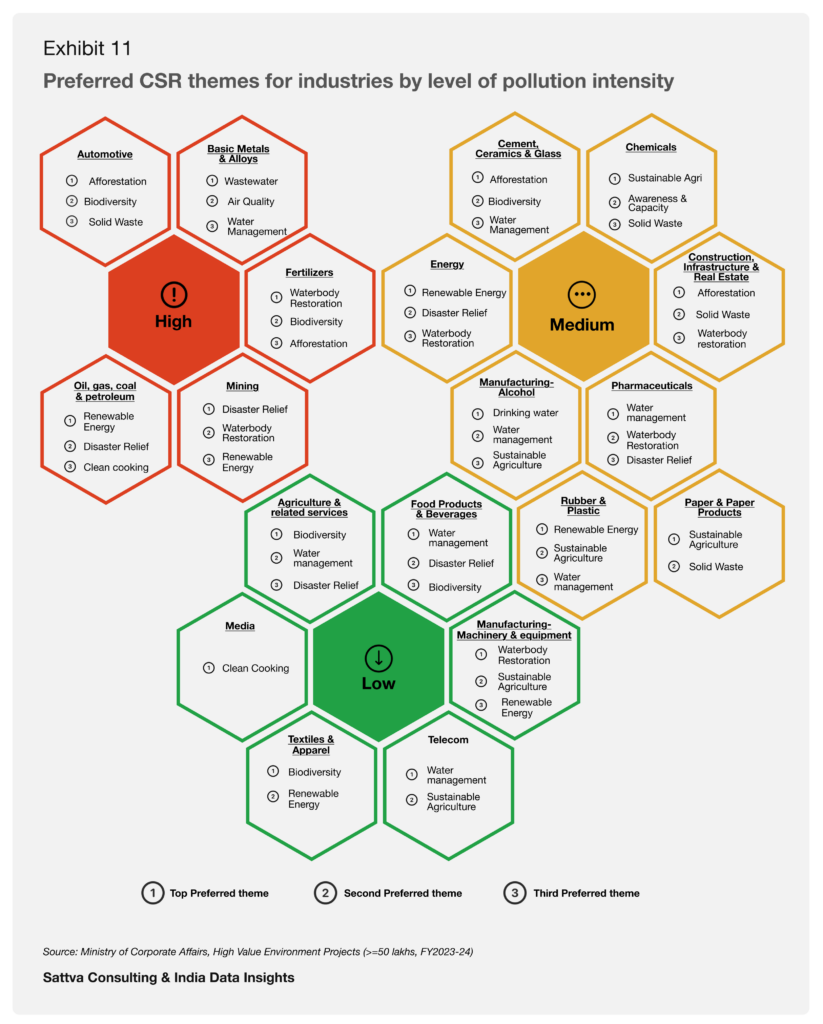
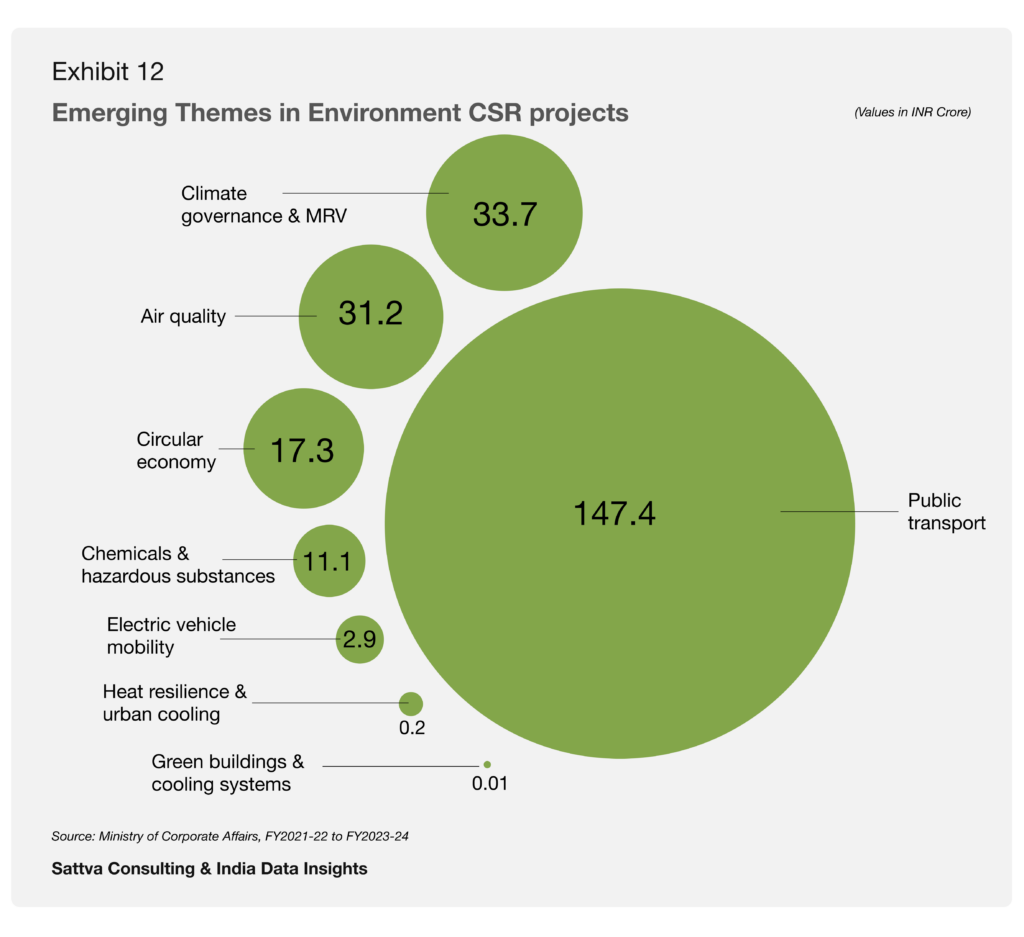
These choices reflect a tendency to prioritise projects that allow for clearer attribution to social outcomes and more immediate visibility of impact. System-level interventions, such as ecosystem restoration or air quality management, involve longer time horizons and more complex measurement frameworks, and are correspondingly less favoured. Should visibility keep shaping where the money goes, or is it time for CSR to back the harder, slower wins too?
Over the past three years, however, ₹243 crore of environmental CSR spend has been directed towards these less conventional areas.
Does environmental CSR spending match India’s climate risk?
The disconnect running through the distribution of environmental CSR is just as evident geographically. Did you know that several highly vulnerable states, including Bihar, West Bengal, Jharkhand, Mizoram, and Arunachal Pradesh, receive less than ₹25 per capita in environmental CSR?
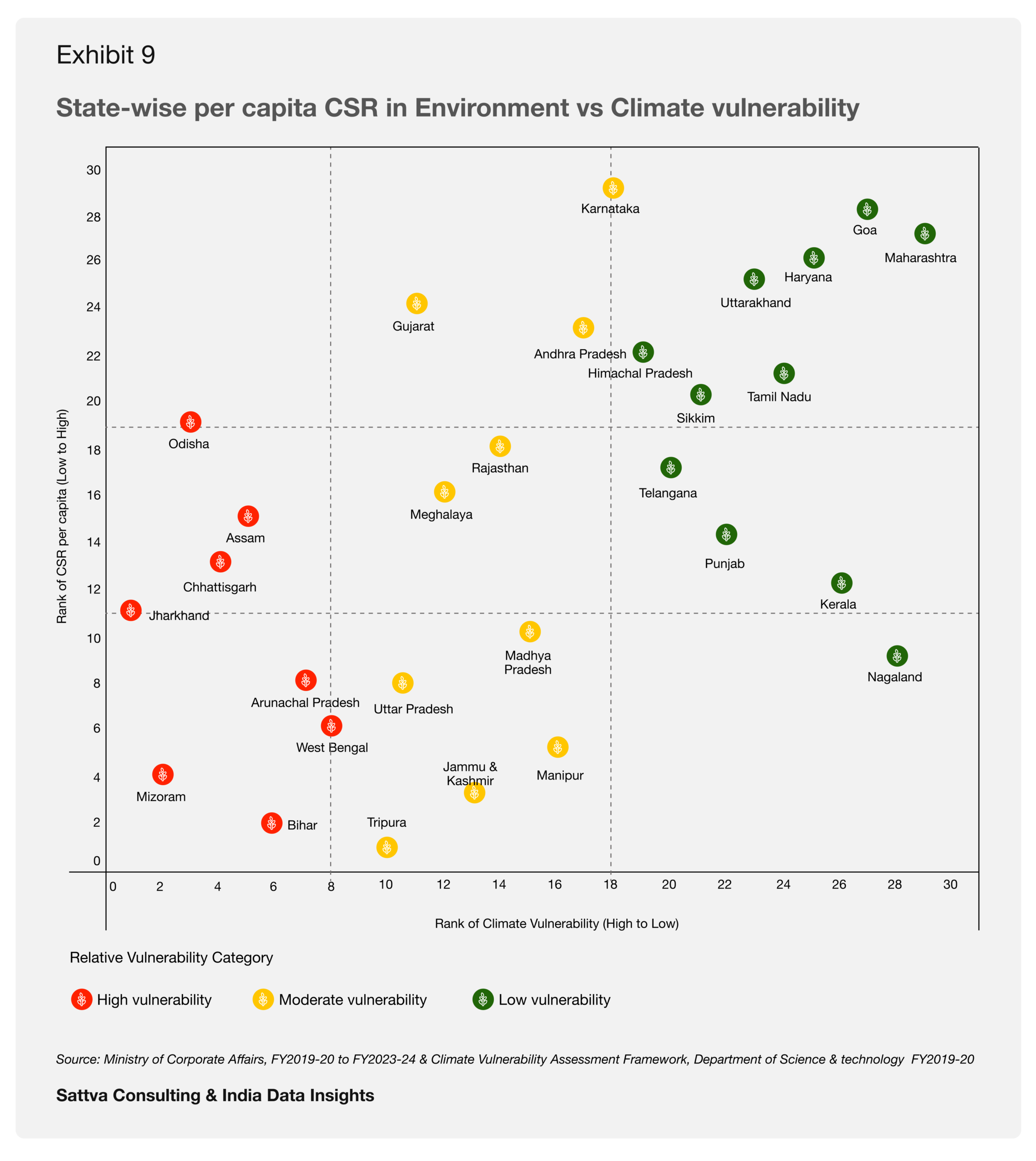
43% of environmental CSR funding goes to pan-India or multi-state programmes, and another 22% concentrates in Tier-1 cities, leaving just 34% for peri-urban, Tier-2+, and district-level work across the rest of the country. The pattern holds at the district level too. Among India’s 50 most climate-vulnerable districts, 30 received only 1% of total environmental CSR spending over the past three years.
While environmental priorities are gaining visibility within CSR, allocations remain fragmented and only partially aligned with the scale and distribution of climate risk. That is precisely the opportunity for CSR to move beyond dispersed, theme-led investment and towards targeted interventions in the high-impact, system-constrained areas where it can play a genuinely catalytic role.
A Decade of Green Spending unpacks exactly where the ₹17,000 crore has gone, which companies and sectors are leading, and where the biggest opportunities for corporate India lie next. It follows CSR’s Next Act, Sattva’s annual State of CSR in India report, and an earlier analysis on why 60% of manufacturing CSR stays within plant districts, and draws on the same underlying data infrastructure maintained by India Data Insights.
A decade of green spending: What ₹17,000 crores of environmental CSR reveals about corporate India
Read the full report by Sattva Consulting & India Data Insights · July 2026
Frequently asked questions
How much has corporate India spent on environmental CSR in the last decade?
₹17,377 crore between FY2014-15 and FY2023-24, based on disclosures filed with the Ministry of Corporate Affairs.
What share of total CSR spending goes to the environment?
8.4% in FY2023-24, recovered from a pandemic-era low of 4.4%, but still behind health and education as CSR priorities.
What is CSR in environmental management?
Under India's CSR framework, environmental CSR covers company spending on environmental sustainability, conservation of natural resources, and agroforestry, activities recognised as eligible CSR themes under Schedule VII of the Companies Act, 2013.
What is the 2% CSR law in India?
Under Section 135 of the Companies Act, 2013, companies above certain thresholds of net worth, turnover or net profit must spend at least 2% of their average net profit from the preceding three years on CSR activities, which can include environmental sustainability among other eligible themes.
Which companies spend the most on environmental CSR in India?
Participation is low overall, just 22% of companies fund it, but 68 large firms account for over 40% of total environmental CSR spending.
Do high-pollution sectors spend more on environmental CSR?
Not proportionally. Sectors such as oil, gas, coal and mining show strong participation but allocate only a small share of their CSR budgets to the environment, most of their environmental investment likely happens outside CSR.
Which Indian states get the least environmental CSR funding relative to their climate risk?
States including Bihar, West Bengal, Jharkhand, Mizoram and Arunachal Pradesh, all highly climate-vulnerable, receive under ₹25 per capita in environmental CSR.