In 2014, India became the first country in the world to enforce Corporate Social Responsibility. More than a decade later, the progress is visible not just in the cumulative spend of Rs. 2.6 lakh crore, but in the evolving role corporates now play as co-solutionists to India's biggest developmental challenges. Emerging FY24-25 data shows a CSR corpus of at Rs. 40,794 crore last year alone, and the intent to contribute meaningfully, not just compliantly, is becoming clear: More than half of donor companies have continued to overspend beyond their mandate since 2021. High-poverty districts have seen a 121% increase in CSR spend. Between FY21-22 and FY24-25, historically underfunded states saw the sharpest rise in CSR inflow: Jammu & Kashmir at 347.5%, Jharkhand at 337.1%, and Punjab at 216.6%. Sattva Consulting's work with companies in crafting CSR strategies has given us a front-row seat to not just the growing numbers, but the philosophies behind them, and the opportunities that await. Here are our CSR recommendations for companies, based on more than a decade of social impact consulting.
As per CSR's Next Act, companies' CSR decisions are increasingly aligning with business needs, strategy, and expertise, while diversifying in terms of geography and recipients of funding.
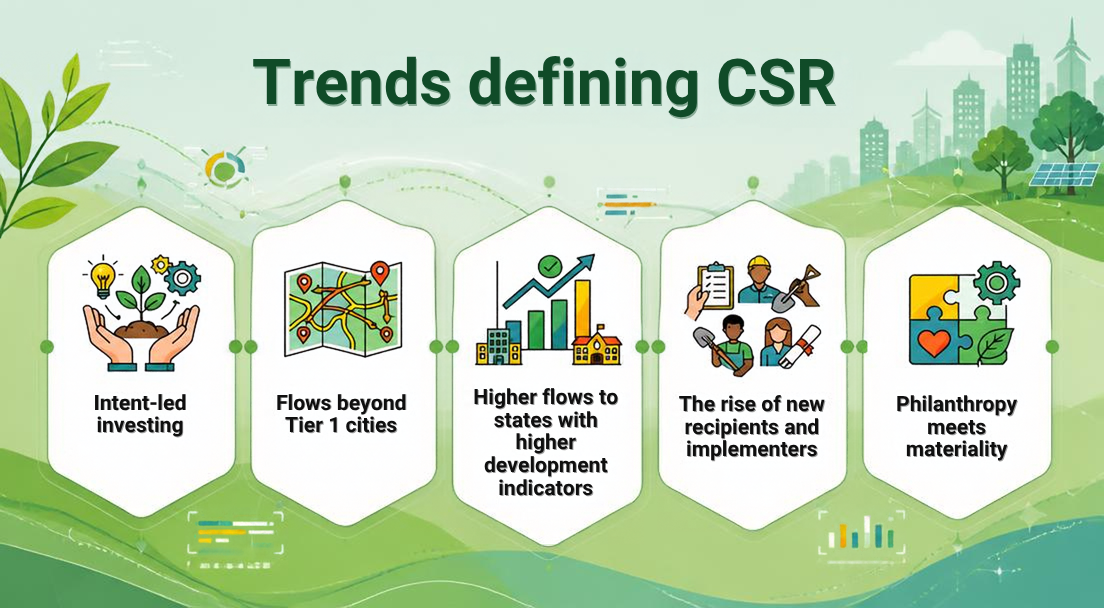
Intent-led investing. Smaller companies (with budgets under Rs. 1 crore) are overspending, while larger firms (budgets exceeding Rs. 50 crore) are committing to multi-year projects. In FY24-25, 63% of firms with a budget less than Rs. 1 crore overspent. In FY23-24, 30% of all CSR projects were tagged "on-going." This multi-year dedication is good news for implementers, since lasting impact rarely wraps up as neatly as a financial year.
Beyond Tier 1. CSR flows have amplified in Tier 2 and 3 cities, industrial regions, and aspirational districts, shaped by environmental footprints, "home-state" affinity, and general alignment with business needs and expertise.
Higher flows to states with higher development indicators. Despite increased investments in underfunded states, CSR per capita is still higher in states that are already faring well. Stay tuned as we explore this in detail in our upcoming CSR report.
The rise of new recipients and implementers. Historically, nonprofits were the primary CSR recipients. Today, specialised institutions — hospitals, universities, incubators, sports associations, religious trusts, and corporate foundations — are drawing funds too.
Philanthropy meets materiality. Firms are increasingly approaching CSR from a shared-value perspective, addressing challenges that affect both their business and the country, leveraging their unique strengths, and integrating CSR and ESG strategies into one coherent narrative.In the context of these shifts, the question for corporates is no longer how much to give, but how well to give. That starts with a change in mindset.
Changing corporates’ mindsets: Foundational best practices in CSR
The most fundamental way for a firm to strengthen its CSR is to change how it thinks about social impact creation. Sourav Roy, CEO of Tata Steel Foundation, elaborates on this in an episode of Decoding Impact:
Acknowledging the complexity of CSR work. Creating social shifts is a technical skill. A CSR manager is expected to connect with communities, hold multi-thematic expertise, stay on top of evidence and research, manage programmes effectively, and oversee funding — all while balancing business realities with ground realities. When firms understand the depth of work behind impact creation, they're more likely to invest in their CSR teams and align business strengths with CSR strategy.
Listening to what communities say — and what they don't. Connecting with communities means navigating nuance: understanding their struggles, triumphs, aspirations, and dreams; how they conceptualise the future; what they share and what they hold back; and what might prompt silence even in safe conversations. Corporates that grasp this complexity are better able to track their CSR programmes beyond outcome metrics, and genuinely care about how communities are affected.
Harnessing business strengths. Impact creation isn't the CSR team's job alone. Corporate volunteering, technical expertise from other business functions, and organisational networks can all be mobilised toward CSR goals, turning a siloed function into a company-wide effort.
Imbibing perspectives and wisdom from communities. Sourav points to Unurum, a Tata Steel Foundation immersion programme where participants — often college students or working professionals — live with rural communities, engage in in-depth conversations, understand lived experience, and take part in continuous knowledge exchange. Local knowledge systems have much to teach firms: a sarpanch, for instance, often has hard-won lessons in effective management that no MBA case study can replicate.
New opportunities for CSR in 2026
This decade holds the potential to reframe the role of corporates in solving India’s biggest development challenges: from grant-makers to problem-solvers, from funders to system co-creators. On this front, new opportunities for CSR emerge:
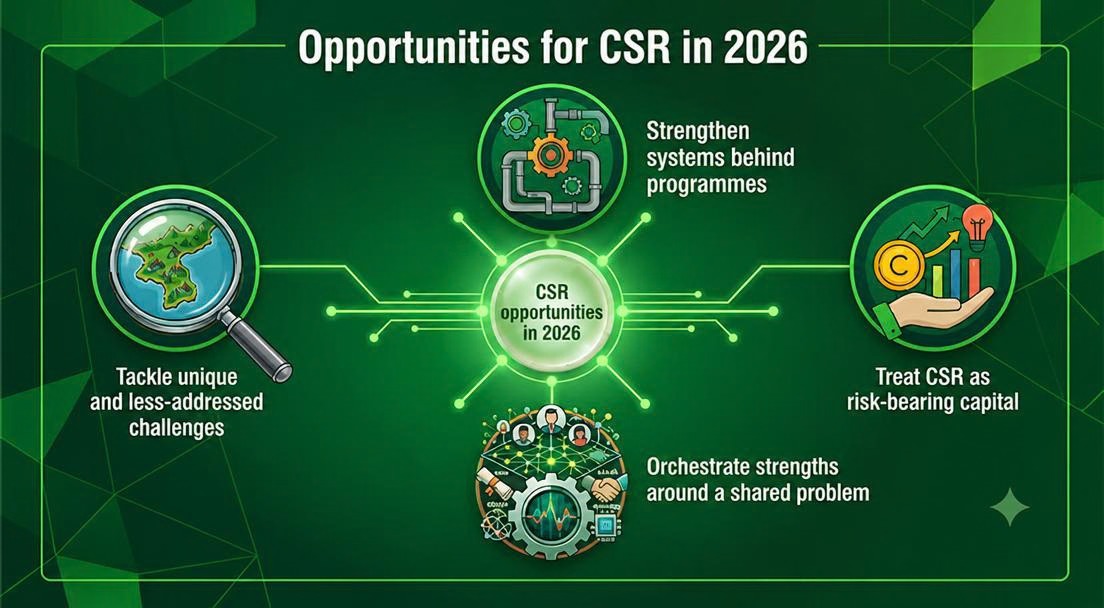
1. Tackle less-addressed challenges, within business-aligned contexts: Manufacturing companies’ CSR tends to largely stay within operating districts, or “Plant Districts.” Thematically, these projects are usually within Education, Health, or Rural Development, focused on immediate service reinforcement rather than systemic transformation. Livelihoods and Environmental Initiatives remain underfunded. Firms that choose to pick up underacknowledged, but high-potential areas for systemic change enable holistic development and may even encourage other companies to do the same.
2. Orchestrate strengths around a shared problem, not just pool funding. Corporates bring a lot more to the table than just capital when it comes to social impact, including technical expertise, networks, data, and influence. The next phase of corporate philanthropy is mobilising companies to pool their complementary capabilities to solve challenges multidimensionally.
3. Treat CSR as patient, risk-bearing capital for innovation. Climate innovation, edutech, or digital health, there are a plethora of promising solutions that need their first ray of hope. That’s where CSR can come in, as patient, risk-bearing capital for innovation, where conventional funding is not yet ready to commit. Further enabled by corporate talent, technology, and network, solutions that were deemed too risky may be able to enter the market, earn greater investment, and be adopted at a wide scale.
4. Strengthen the systems behind the programmes, not just the programmes themselves. This is where corporates can step in fully to the role of system co-creators. Supporting institutions, systems, and infrastructure through building organisational capacity, taking up ecosystem coordination, providing suitable financing mechanisms, or shared data and evidence. Shifting focus from investing in individual programmes to the whole systems gives scope to enable other programmes, organisations, and institutions.
Conclusion
A decade after India mandated CSR, the conversation has moved decisively past compliance. The data tells a clear story: companies are overspending their mandates, committing to multi-year work, and reaching further into underfunded geographies than ever before. But the more important shift is qualitative — in how corporates think about social impact creation, and where they see themselves within it.The firms that understand the depth and complexity of moving the needle may also see how much they can give – beyond capital – in creating systemic change. Increasing business alignment only reinforces this, corporates have the talent, tech, networks, and capabilities to strengthen systems, support early-stage solutions, and address underfunded sectors, themes, and regions. The question now isn't whether corporates can be partners in India's development. It's how far they're willing to go.