
India has made significant progress in bringing women into the formal financial system. In 2014, only 43.1% of Indian women aged 15 and above had an account at a financial institution, compared with 62.8% of men. By 2024, account ownership had risen to 89.2% among women and 88.8% among men.
The scale of this expansion is also reflected in the Pradhan Mantri Jan Dhan Yojana (PMJDY) which reported 59.31 crore beneficiaries, including 33.04 crore women as of September 2026.
While this is a momentous achievement, it also raises an important question.
When Does Access Lead to Empowerment?
A bank account in a woman’s name is an important baseline for access. However, ownership alone does not tell us whether she actively uses the account, understands the financial products available to her, or has a say in decisions about her money.
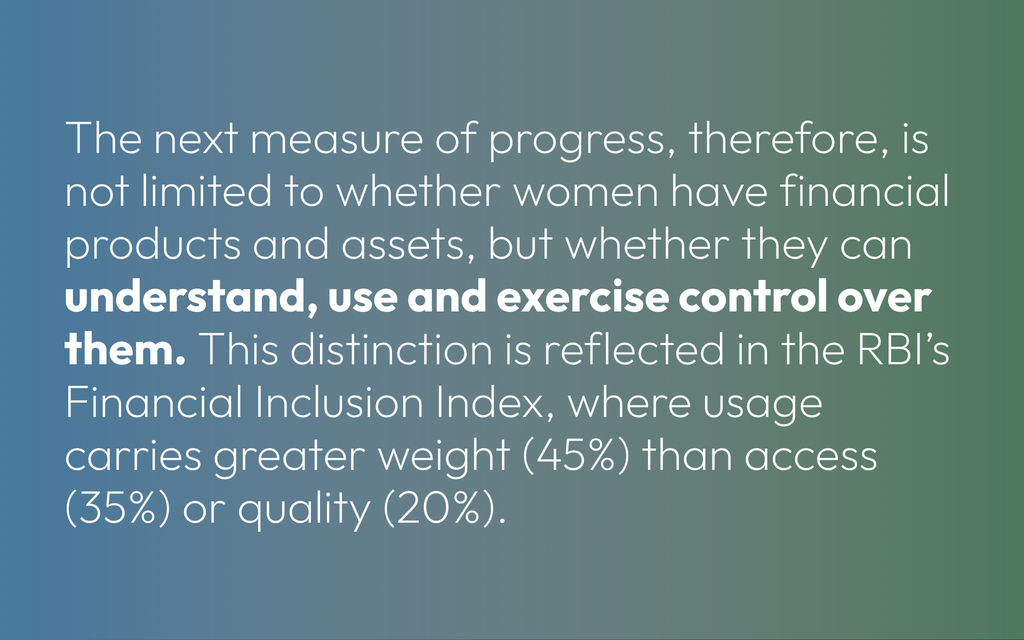
The ultimate frontier of financial inclusion, therefore, is agency: the ability to understand, use and influence financial decisions and resources in ways that strengthen a woman’s economic choices. Even so, access does not automatically yield agency, awareness serves as the essential bridge between the two.
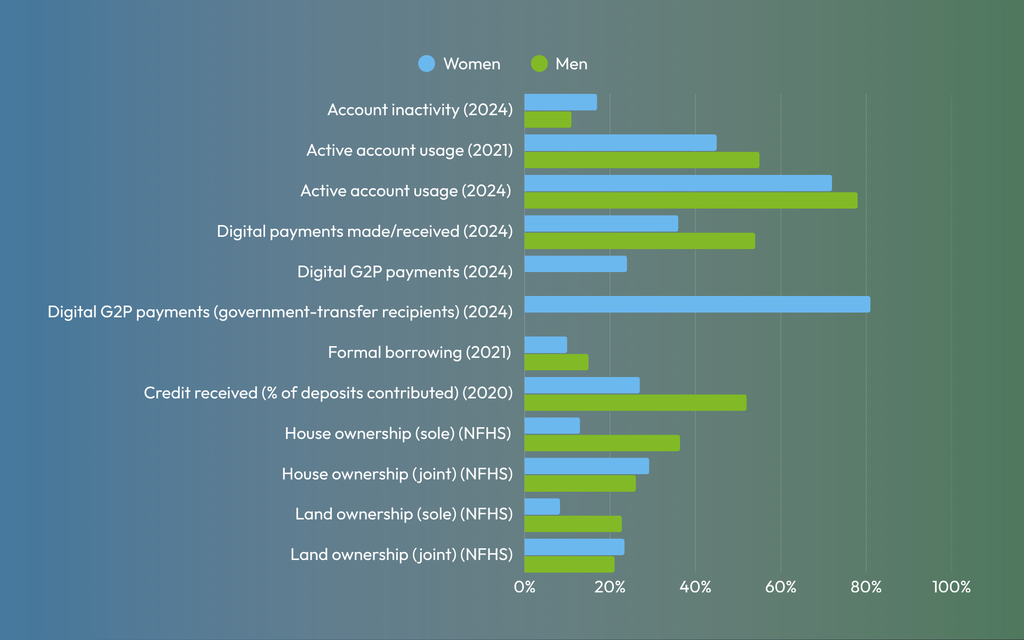
India has made significant progress when it comes to access. In 2024, 89.2% of women had an account, virtually closing the gender gap in account ownership. Yet, usage remained uneven: 36% of women made or received a digital payment during the year, compared with 54% of men. At the same time, women’s engagement with digital financial services has been growing. The share of women receiving government-to-person (G2P) payments digitally rose from 13% in 2021 to 24% in 2024.
These trends point to greater integration with formal financial systems. However, engagement does not necessarily translate into agency. Receiving money digitally, for instance, indicates access to a formal financial channel, but not whether a woman manages those funds, understands the products she uses, or has a say in how the money is spent.
Further, a comparison of NFHS-4 and NFHS-5 data across 17 states by PRS Legislative Research illustrates this gap: while the proportion of women with a savings or bank account increased across all 17 states, the proportion of women owning a house or land, including joint ownership, declined in 9 of the 17 states.
Awareness: The Missing Link
In a study with workers at warehouses of a leading logistics company in Delhi, we assessed the experience of Earned Wage Access (EWA), a financial well-being tool that allows workers to access a part of their earned wages before the regular salary cycle. Yet, many women workers were unaware that EWA was available to them, let alone how it worked or how to use it. Many even had formal salary accounts, but were unfamiliar with the structure of salary slips, deductions, and the features, costs and obligations attached to financial products.
The gap is not limited to awareness of financial products. It can persist even when women contribute financially to an asset. In a study with an affordable housing finance company examining the impact of homeownership on low- and middle-income households, women spoke of the pride, confidence and security that came with owning a home. Many had contributed through years of savings or by selling jewellery, often among the few assets they owned independently, and yet the property was not registered in their name. They had contributed to financing an asset without securing legal ownership, limiting their ability to claim it as an independent financial asset.
The same disconnect is evident across financial products. In another study across South Asia where we assessed the impact of commercial banks, we found that when women are recorded as borrowers, it is their spouses who manage the loan, negotiate the terms, manage repayments and determine how the funds are used.
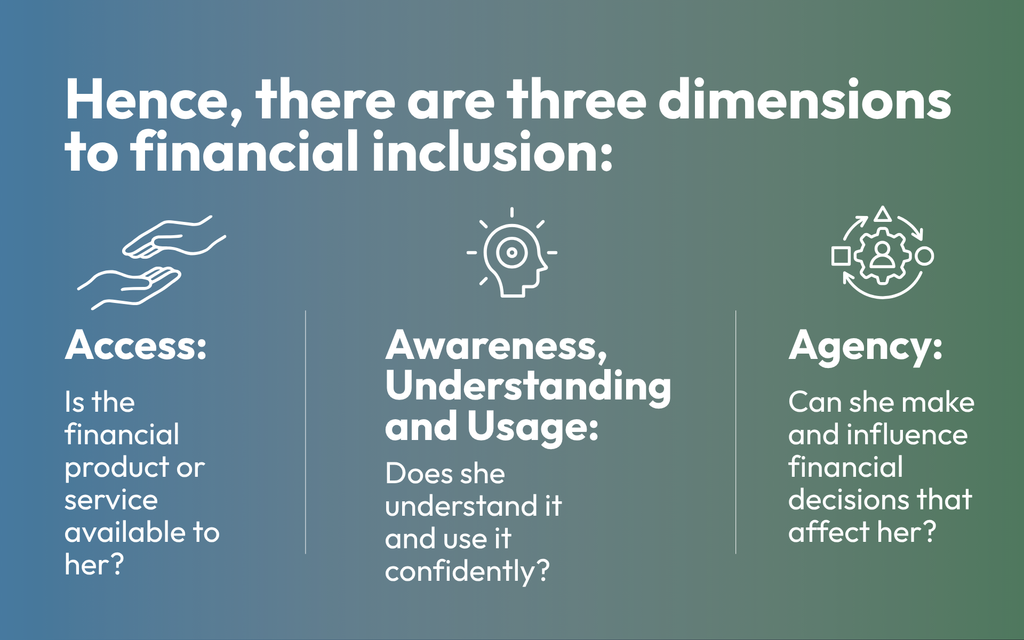
Taken together, these experiences highlight a critical distinction between access, awareness and agency.
A loan in a woman’s name demonstrates that a financial product has reached her. Whether she knows its interest rate, understands the consequences of default, participates in repayment decisions and can exercise her rights tells us about her financial agency.
From Access to Agency
Access creates the possibility of inclusion, awareness determines if women can engage with what they have access to, and agency shapes whether that engagement translates into greater control over financial decisions and resources.
The good news is that India’s financial education architecture is already reflecting this shift. The National Strategy for Financial Education 2020–25 took a broader view of financial literacy, spanning knowledge, skills, attitudes and behaviour. The RBI’s implementation agenda under the National Strategy for Financial Inclusion also identified process literacy alongside concept literacy as a priority. By September 2024, 2,421 Centres for Financial Literacy were operational across 7,225 blocks.
Similarly, programmes of the National Centre for Financial Education focus on practical financial capabilities across savings and credit, digital transactions, insurance, pensions, fraud protection and grievance redressal.
The Next Frontier of Financial Inclusion
The next phase of financial inclusion requires institutions to move beyond measuring reach to understanding what women are able to do with the financial services they have access to.
1. Build financial education into product delivery
Financial literacy is most useful when it is embedded in the product experience.
When a woman takes a loan, opens a bank account, purchases insurance or uses a credit product, she should receive clear, accessible information on its terms, costs, obligations, rights and avenues for redressal.
The goal is not to make every customer a financial expert. It is to ensure that every woman can understand the financial decision she is making, the commitments it entails, and the choices available to her.
2. Measure usage and control
Accounts opened, loans disbursed and policies issued remain important measures of reach. But, institutions and funders can go further to bring usage, understanding and decision-making into the framework by asking:
- Who operates the account?
- Who initiates transactions?
- Who understands the product?
- Who negotiated the loan?
- Who decides how savings are used?
- Who knows their rights and how to exercise them?
3. Link asset creation to legal ownership
When women contribute financially or materially to an asset, programmes can track their contribution against legal ownership, distinguishing between sole ownership, joint ownership and contribution without documented ownership. In housing and livelihood interventions, this can indicate whether women’s financial participation translates into long-term economic security.
4. Design research around the woman, not the household representative
When the male member in the family is the default respondent, it is easy to miss the distinction between an asset being held in a woman’s name and her actually understanding or controlling it. Hence, creating opportunities to hear directly from the woman named on the account, loan, insurance policy or asset is critical. This includes speaking to women directly via interviews, women-only discussions and product-level follow-ups, rather than relying on the household representative who is most available or considered most knowledgeable.
Redefining the Measure of Progress
India has demonstrated that financial access can be scaled at speed; the near-elimination of the gender gap in account ownership shows what coordinated policy, digital infrastructure and financial delivery can achieve.
The next phase is about turning access into agency, calling for a shift across the ecosystem:
- Financial institutions can look beyond acquisition to focus on comprehension and usage
- Corporates and CSR programmes can assess outcomes beyond reach
- Investors and funders can support models that build sustained capability
- Policymakers can strengthen the systems that enable meaningful participation
All views expressed are personal and do not necessarily represent those of the organisation.
Looking to develop financial inclusion initiatives to strengthen usage, ownership and agency? Write to us at esg@sattva.co.in