

Every woman who can go online through her own phone, every district that has secured 5G access, every new base station that has been constructed. Each is a testament to India’s telecom industry, which has now established 133 crore subscribers, 109 crore internet subscribers, and 5G access to 85% of India’s population. It is the digital backbone of India’s economy, enabling greater access, more livelihoods, national self-reliance, and much-needed research and development.
With the industry’s priorities shifting from access to meaningful digital participation and sustainability, we analyse CSR in telecom – where it flows, falls, and can go even further.
5G covers 99% of India’s districts. But how many people are meaningfully participating online?
Digital infrastructure is a crucial first step – one that the telecom industry has made possible with nearly 5.63 lakh 5G base stations, 42.36 lakh km of optical fibre, and 2.14 lakh Gram Panchayats service-ready on BharatNet.
But a connected India is not the same as an empowered India. Digital access follows the gendered faultlines of society:
→ ~29% of rural women own a smartphone, vs ~50% of rural men
→ 65% of urban women above 30 use internet, as compared to 80% of urban men above 30
The numbers dip even further when analysing digital agency and participation – the ability to transact online, the ability to file complaints – signalling an urgent need to improve digital literacy while bridging gender gaps.
→ Only 19% of rural women over 30 can transact online, compared to 42% of rural men over 30
→ Just 13.8% of Indians can report a cybercrime online. For rural women above 30, this falls to 4.6%
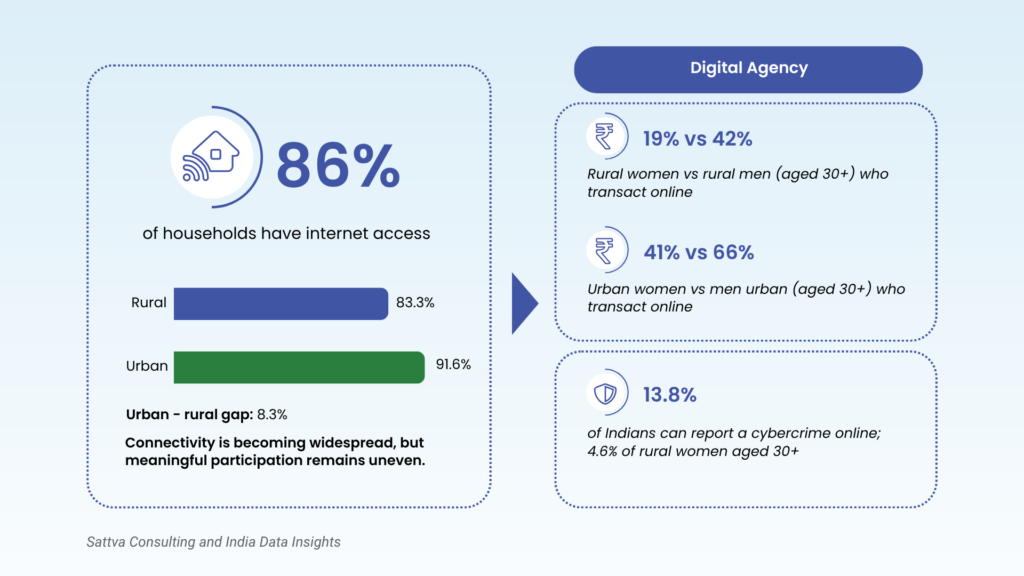
Digital inclusion is one among several mandates that telecom is perfectly positioned to fulfill through its growing CSR investments. A growth rate that is currently outpacing the national average.
Synchronising Frequencies:
A 20.5x growth in telecom CSR over a decade signals the opportunity to turn scale, networks and capabilities into greater impact
Telecom CSR spending hit Rs. 1,073 Cr in FY25. Here are the trends defining it.
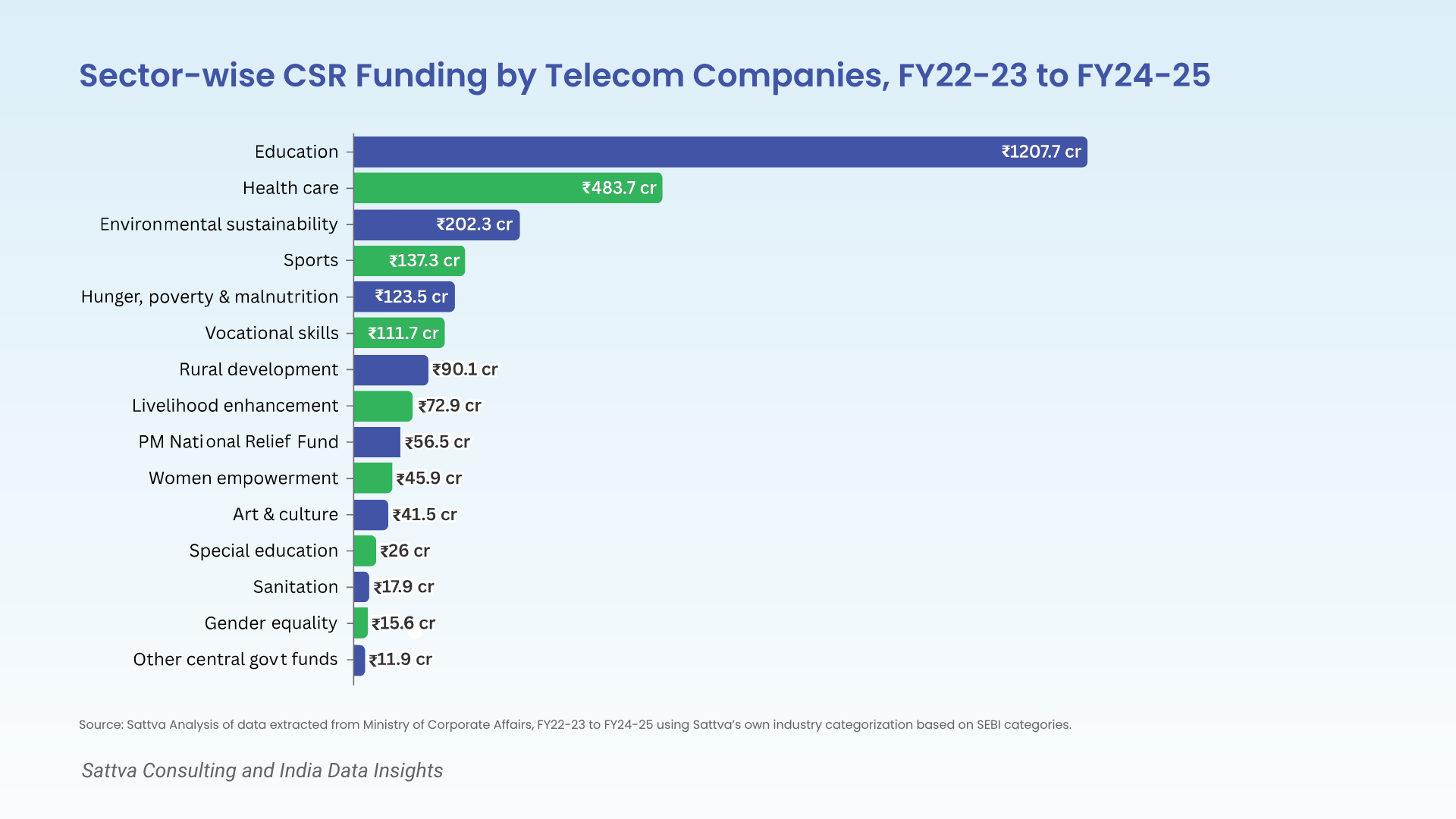
CSR in Telecom has marked a 20.5x increase over the last decade, from ₹52 crore in FY15 to ₹1,073 crore in FY25. With an approximate Compounding Annual Growth Rate of 35%, it’s outpacing the 15% CAGR of national CSR.
A few heavylifters anchor the sector’s CSR: 10 companies contribute 76% of the total. Of this, the top 3 account for 62%. Reliance Jio Infocomm alone contributes 44%.
Education, health, and rural development are priorities: Education earns 45% of CSR in telecom, and health 18%. When the influence of the top 3 funders is stripped away, rural development and livelihoods emerge as strong priorities, outdoing the national averages (rural development attracts 7% of telecom CSR vs 6.5% nationally; and livelihoods garner 7.1% of telecom CSR vs 6.2% nationally).
Funds flow beyond company HQ, but not beyond national trends: 65.9% of geographically attributable spend goes outside company HQ states, against 47.7% nationally. However, even excluding the top 3 funders, five states – Maharashtra, Karnataka, Haryana, Tamil Nadu and Delhi – account for 61% of telecom CSR. Between FY23-25, only 7.6% of telecom CSR reached Aspirational Blocks, compared with 13.9% nationally.
The link to digital access is not steady: While the higher-funded states have stronger digital access, especially among women, low-access states see uneven levels of funding. Odisha and Jharkhand receive just 0.6% and 0.3% of telecom CSR, while Bihar and Rajasthan receive 1.3% and 5.5%, slightly above their national CSR shares.
What kinds of CSR initiatives can the Telecom Sector look at, going forward?
Telecom is already investing in the right places. The opportunity now is to go deeper, and to draw on what the sector does best: networks, engineering and reach.
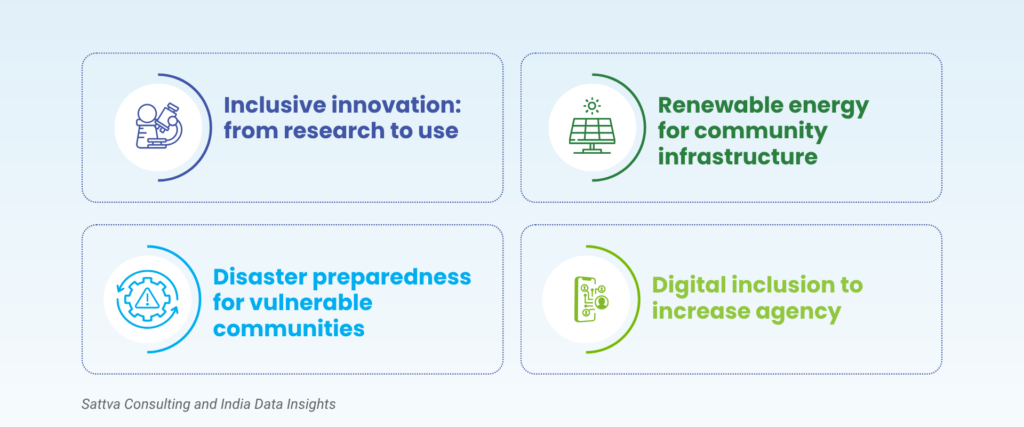
Digital inclusion – from connecting people to equipping them: Telecom CSR already gives digital inclusion far more weight than national CSR overall, at 9.6% of spend vs 1.7% nationally. But most of it still flows into platforms, infrastructure and literacy. The skills that make someone confident online, such as staying safe from fraud and managing money digitally, barely register (cyber safety gets under 1% and digital finance none at all). The next step is to build agency: help women, first-time users and rural communities transact, protect themselves and claim their entitlements, not just get online.
Enabling prototyping and pilot programmes in innovation: Telecom CSR supports STEM education and tech talent, while little reaches the stage where a prototype becomes a pilot, and a pilot becomes something communities actually use. With R&D labs, live network testbeds and chip and device expertise in-house, the sector can help bridge that gap.
Bringing renewable energy infrastructure to communities: Roughly one in four rural health sub-centres has no electricity supply. Telecom CSR can carry the sector’s energy infrastructure expertise to schools, primary health centres and anganwadis, aligned with the Draft Telecom Policy’s push towards renewable-powered towers.
The last mile of disaster preparedness: With last-mile reach and network access in place, the Telecom sector can strengthen early warning systems and last-mile communication systems to increase disaster preparedness.
Telecom as a nation-builder
Three shifts can help telecom CSR move from scale to nation-building impact. First, synchronise investments so that companies in the sector and its adjacent industries work together on place-based outcomes, particularly in underserved geographies with significant digital access gaps. Second, bring business capabilities, including technology, expertise and networks, to national priorities, so that CSR contributes more than capital to nation-building. Third, use telecom’s position as a platform to bring in industries that depend on its infrastructure, such as financial services, IT and media, to take on shared development priorities with a multiplier effect.
The sector has built the network that connects India. With the right alignment, its CSR can help ensure that the connection is felt in every community the network reaches.
Synchronising Frequencies
A 20.5x growth in telecom CSR over a decade signals the opportunity to turn scale, networks and capabilities into greater impact