
Key takeaways
→ Under the Companies Act, nonprofits must be registered as a Section 8 company, public trust, or a society to receive CSR funds
→ If a business formed abroad, a foreign multinational, or the Indian office of a foreign company wants to channel its CSR funds to an Indian nonprofit, the Foreign Contribution Regulation Act comes into play.
→ Nonprofits can spend CSR on topics determined under Schedule VII of the Companies Act, including health, education, gender, environment, arts & culture etc.
→ Nonprofits can now raise funds on the Social Stock Exchange using Zero Coupon Zero Principal bonds, which have their own regulations
→ Under the Companies Act, Nonprofits provide corporates the data needed to report CSR activity. Under the FCRA, reporting is an NGO’s responsibility
→ As the CSR landscape transforms, capacity building, strong due diligence, and long-term strategising will become essential for Nonprofits
For more than a decade, nonprofits have been the main recipients and implementers of CSR in India. This receiver-base is widening to include specialised institutions, such as hospitals, religious trusts (only for secular work), and sports associations. CSR rules too, have undergone changes, with corporates now being allowed to invest up to 10% of their CSR expenditure in the Social Stock Exchange via Zero Coupon Zero Principal (ZCZP) instruments.
These shifts reinforce both the fundamental need for nonprofits to be compliant with CSR laws in India, and the imperative to build organisational capacity to attract corporate philanthropy.
What CSR regulations in India apply to non-profits?
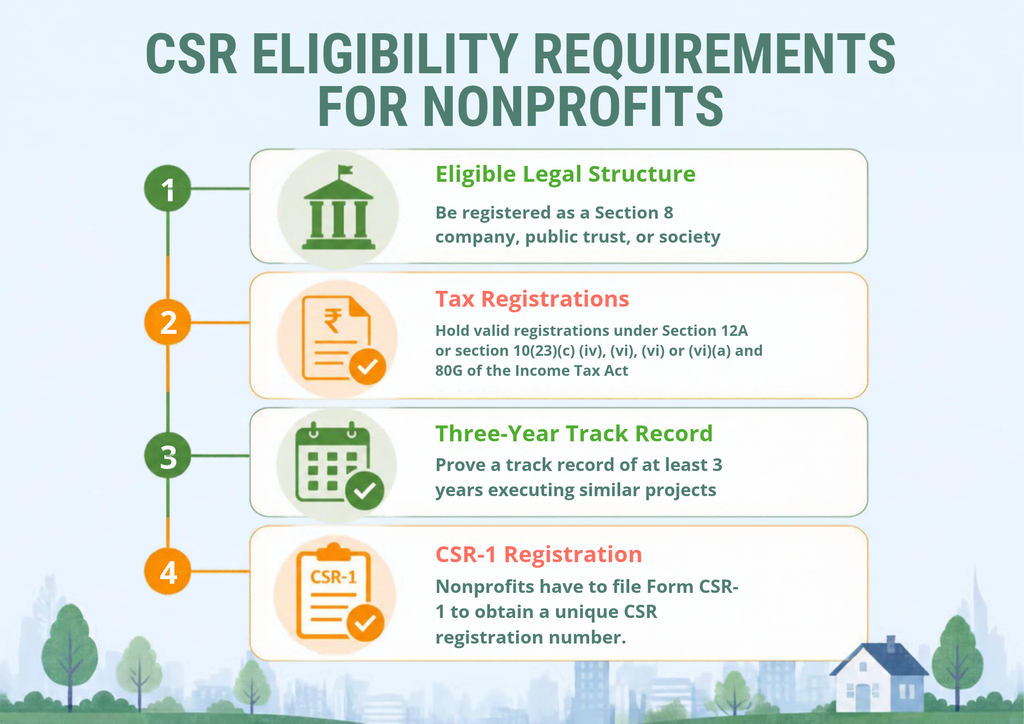
For a nonprofit to be eligible to receive CSR funds, they must:
- Be registered as a Section 8 company, public trust, or society
- Hold valid registrations under Section 12A or section 10(23)(c) (iv), (v), (vi) or (vi)(a) and 80G of the Income Tax Act as per the 2022 amendment to the CSR Rules. Sec 12A enables charitable organisations – including NGOs – to seek an exemption from income tax on income. Section 10(23)(c) (iv), (v), (vi) or (vi)(a) provide tax exemptions for the income of specific charitable, religious, educational, and medical institutions upon approval by the Principal Commissioner or Commissioner of Income Tax. 80G enables donors to claim deductions on donations made to such organisations.
- Prove a track record of at least 3 years executing similar projects through documentation such as audited financial statements, project reports, or impact assessment data.
- Since 2021, nonprofits have to file Form CSR-1 to obtain a unique CSR registration number. This enables a centralised monitoring system to verify that only registered organisations are engaging in CSR.
Please note that if a business formed abroad, a foreign multinational, or the Indian office of a foreign company wants to channel its CSR funds to an Indian nonprofit, the Foreign Contribution Regulation Act comes into play. (If it is a subsidiary incorporated in India, then as long as the investment from the foreign parent company is within the approved FEMA limits, CSR contributions by such Indian companies are treated as domestic funds, not foreign funds.)
Every nonprofit receiving such funds must be registered under the FCRA law and have an FCRA-specific bank account. As of June 2026, the Foreign Contribution (Regulation) Amendment Rules, 2026, mandates that:
– Organisations need to specify their purpose of registration – Religious, Educational, Cultural, Social, or Economic – and the state/UT in which they plan to be active.
– To renew registration, nonprofits must prove that they have undertaken ‘reasonable activity’ for the benefit of society utilising at least Rs. 10,00,000 of foreign funding received in the last 2 years.
– They disclose social media accounts, articles, blogs, posts, books along with detailed project reports of both the organisation and key functionaries.
Read more about what FCRA means for nonprofits here: https://www.indiapartnernetwork.org/wp/resources/stay-compliant-stay-confident-understanding-fcra-for-ngos/
What are the CSR spending rules for nonprofits?
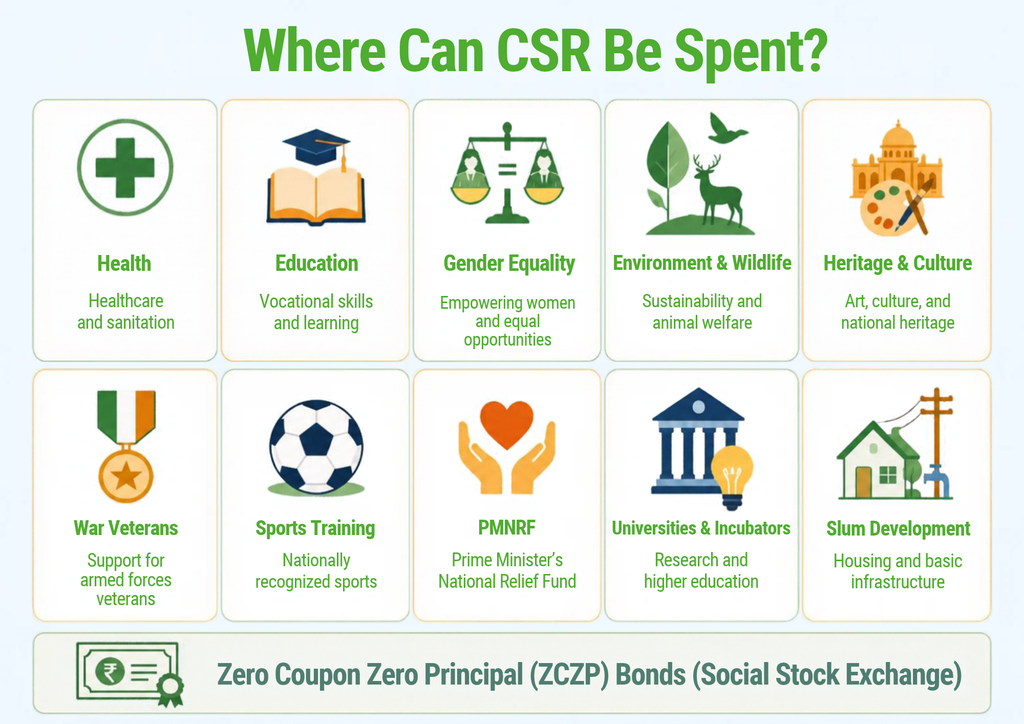
Under the Companies Act, CSR funds can be spent only on the topics specified under Schedule 7:
- health,
- education,
- gender equality,
- environment and wildlife,
- heritage and culture,
- benefits for war veterans,
- training to promote sports,
- contribution to prime minister’s national relief fund, (doesn’t usually involve Nonprofit organisations)
- contribution to universities and research incubators (doesn’t usually involve Nonprofit organisations)
- slum area development,
- and subscription to zero coupon zero principal bonds issued on the Social Stock Exchange
Under FCRA, spending regulations get a bit more complex:
- Administrative costs (including rent, utilities, and in some cases, nonprofit staff salaries) are capped at 20%.
- Nonprofits are not allowed to subgrant funds to smaller nonprofits – each organisation must have its own FCRA registration and bank account to receive foreign funds. However, funds may be paid to a service provider supporting with a portion of delivery as long as there is a valid justification for the same
- Spending on infrastructure and assets using foreign funding/mixed sources may become complex as assets created through these investments may be seized by the government if FCRA registrations are not renewed or cancelled.
Regulations for Nonprofits on issuing Zero Coupon Zero Principal bonds via the Social Stock Exchange
For nonprofits to raise money via Zero Coupon Zero Principal bonds on the Social Stock Exchange, they need to be registered as a society, Section 8 company, or charitable trust, with valid PAN, TAN, and GST number, and registrations under 80G and 12A/12AA/12AB under Income Tax Act. The nonprofit must be working within the 17 broad areas of eligible social objectives specified by SEBI, targeting underserved populations or regions of low performance on development priorities, and 67% of their activities should be eligible activities serving their target population – either in terms of revenue earned, expenses incurred, or customer base.
They must also qualify for either of these two tiers:
- A minimum 3-year track record of operations, a minimum of Rs. 50 lakh spent in the previous financial year, and at least Rs. 10 lakh received in funding
- Aspiring nonprofits that want to register on the Social Stock Exchange need to have a minimum 2-year operational history, a minimum of Rs. 25 lakhs spent in the previous financial year, and at least Rs. 5 lakh raised in donations
NPOs must use the funds received from ZCZP for projects that are completed within 3 years, and unspent amounts, if any, at the end of the timeline must to transferred to a permissible fund under Schedule VII of the Companies Act, 2013, such as PM Cares, PMNRF, Clean Ganga etc.
Reporting requirements for nonprofits include adherence to the Minimum Reporting Standard (MRS), a financial audit, and a social impact audit. The social impact audit is to be conducted by qualified auditors who are empanelled with a Self-Regulatory Organisation, under the Institute of Chartered Accountants of India.
What are the CSR reporting requirements of nonprofits?
Under CSR law: Legal responsibility sits with the donor company, but nonprofits supply the data behind it, such as information for a company’s annual action plan (timelines, monitoring, impact data). For projects worth ₹1 crore or more, NPOs must facilitate an independent impact assessment for annexure to the company’s report. Because the CFO must personally certify fund utilisation, nonprofits are expected to keep audit-ready records for every grant.
Under FCRA: Reporting is heavier and nonprofit-managed, through the MHA portal.
- Annual Return (Form FC-4) — filed every financial year, covering funds received, donor identities, and utilisation.
- Since 2025, if audit reports don’t already show three years of activity-wise expenditure, a separate CA certificate reconciling the figures is required.
- Board/committee changes reported to the MHA within 15 days.
- Annual publication of audited FCRA financial statements on the nonprofit’s own website.
Beyond compliance: How Nonprofits can ready themselves for CSR in a changing landscape
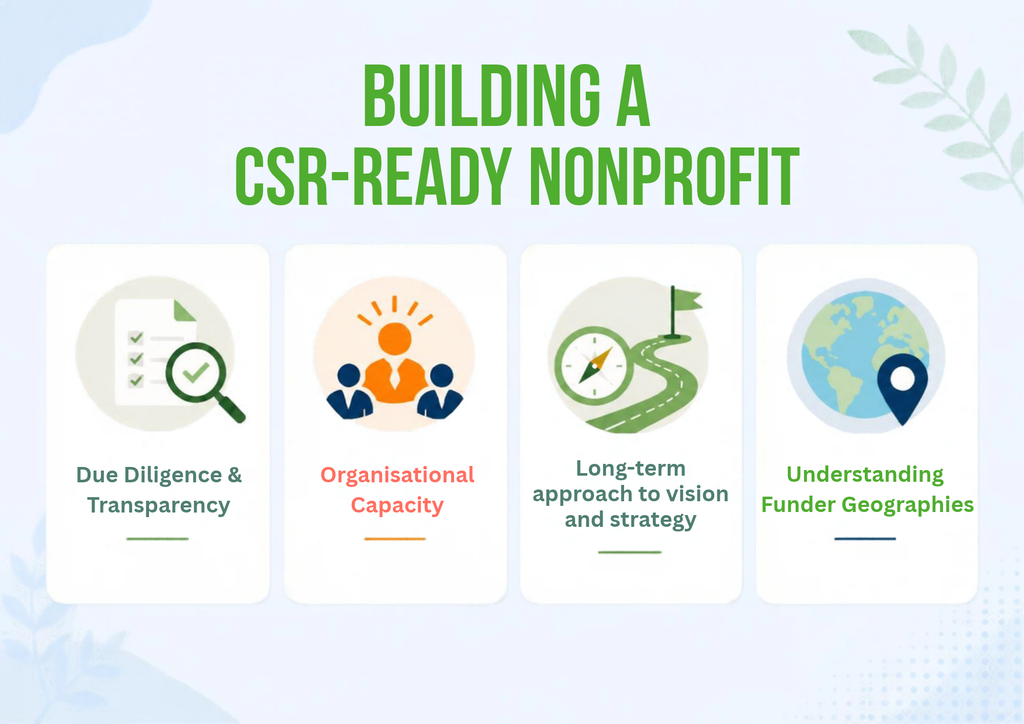
CSR today is characterised by a growing receiver base beyond nonprofit organisations, greater alignment to business needs, expertise, geography, and strategy, and fragmented growth. For nonprofits to keep themselves CSR-ready, it’s important to build:
- Strong due diligence and ensuring transparency, through financial management, governance, and quality reporting
- Organisational capacity, including strong leadership, fundraising capabilities, positioning, pitching, and storytelling
- A long-term approach to vision, strategy, and funder relationships
- Understanding of key funder geographies
Read more about the new logic of CSR and what it means for nonprofits here.
Conclusion
Whether governed by the Companies Act or the Foreign Contribution Regulation Act, the rules around qualifying, spending, and reporting are what stand between a nonprofit and sustained CSR funding — and in 2026, those rules are only getting denser. Registration numbers, quarterly disclosures, geographic and purpose-specific filings: each one is now a checkpoint an organisation must clear, not just once, but on a recurring basis.
But compliance alone won’t make a nonprofit CSR-ready. Corporates are widening who they fund and how they choose to fund them, which means nonprofits also need the organisational muscle to compete for that attention — clear positioning, a fundraising narrative that holds up, and long-term relationships with the right funders in the right geographies.
The nonprofits that treat regulatory compliance as the floor, not the ceiling, and invest equally in capacity and strategy, will be the ones that turn CSR eligibility into CSR outcomes.
If your nonprofit needs support navigating this shift and raising CSR funding, you can check out India Partner Network.