
Urban EV Charging Needs a New Strategy

Share
Join Sattva's mailing list
Get Sattva updates in your inbox every month.

India’s urban EV charging strategy requires a pivot, focusing infrastructure development precisely where it will drive the most meaningful decarbonisation. According to the International Council on Clean Transportation (ICCT), Freight trucks make up only about 5% of India’s on-road vehicles, yet they contribute around 42% of on-road CO₂ emissions, which makes them one of the biggest levers for transport decarbonisation. In a city like Delhi where 80% of the freight movement is within the city, goods move every day through warehouses, mandis, fulfillment centres, and distribution depots, creating intense fuel use in already crowded urban routes. With the Rs 9,585 crore subsidy now set to support more EV adoption, more e-trucks and e-commercial vehicles are expected to enter the road network, but the charging infrastructure they need is still not in place.

Early EV policies, such as FAME I and FAME II predominantly targeted 2W, 3W, and 4W categories. This initiated the development of public charging infrastructure. Unlike petrol/ diesel refuelling, the charging behavior of private vehicle owners was to charge mostly at home. This meant that most of this infrastructure saw limited utilization.

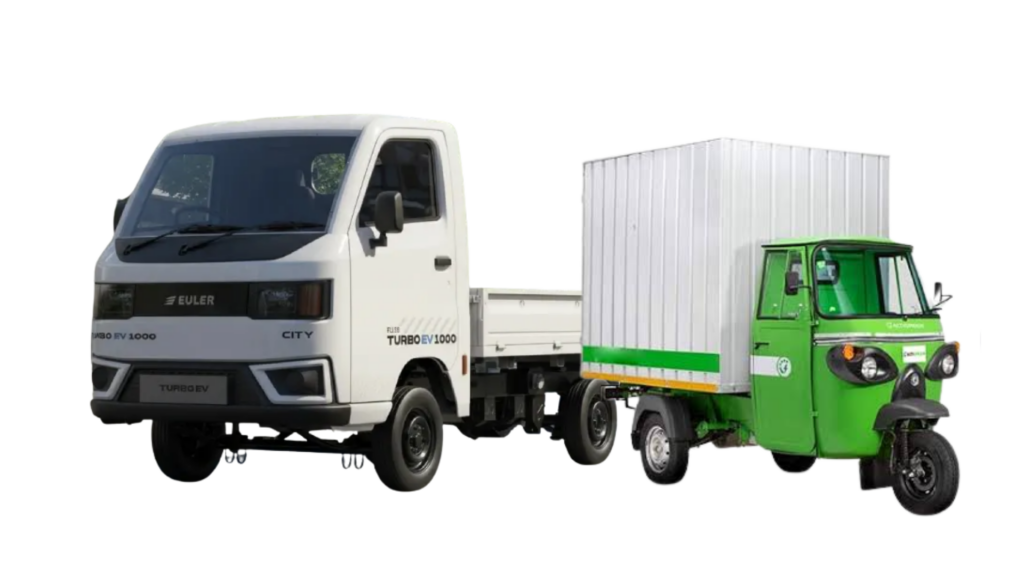
For public charging to work, two things matter most: demand visibility and charging requirement predictability. Urban freight answers both questions well and that is where the real public-charging user appears. This refers to the commercial vehicles responsible for daily vegetable supplies, e-commerce logistics, warehouse to dark store operations across the city every day. These vehicle operators generally live in co-living spaces close to the warehouse with other drivers or at home away from the warehouse, neither of which have the facilities to charge freight vehicles like the Tata Ace EV or Mahindra Treo Zor. They park near warehouses, mandis, or depots, and they need charging that fits their operating rhythm. If this charging is made available, more freight can shift from diesel to electric, and that directly supports decarbonisation.
 

In one consultation with a freight aggregator in Delhi, the message was direct: urban freight movement is predictable with fixed routes and halt  points. The charging need should be just co-located. For instance, a driver based out of Bamnoli in Southwest Delhi may run 40 – 80 km per trip, make two trips a day, and return to the same sub-zone in the evening. He needs to charge his vehicle within 2–3 km of their residential area in the same sub-zone. Charging for urban freight EVs must therefore be planned at the sub-zone level, not the city level.

These conversations also surfaced another important aspect: the need for slow charging equipment for Small Commercial Vehicles. While fast charging enables quick turnarounds, industry experts recommend at least one slow charging session for every four fast charging sessions to ensure battery health, cell balancing, and longevity. In a conversation with an early operator, they mentioned that  primarily the drivers have access to only fast-charging networks, forcing many to rely on informal charging options. The individual highlighted how common it is for drivers to use unprotected/ unsafe charging at Dhabas and Workshops simply because they have no better alternative. That is not just inefficient. It is unsafe. It also shows that some demand already exists. The system thus needs to catch up and meet this demand.

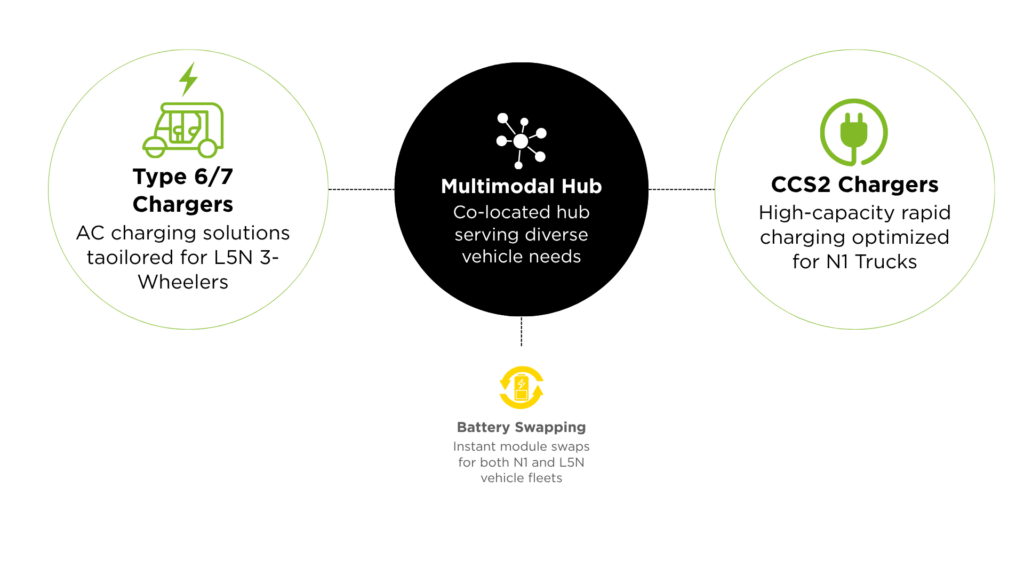
Another interesting observation shared with us was that urban warehouses typically manage a mix of L5N (three-wheeler) and N1 (four-wheeler) freight. This dual-vehicle operational reality means that charging infrastructure cannot be restricted to a single vehicle or charger type. Specifically, L5N three-wheelers require Type 6 or Type 7 chargers, whereas N1 small commercial vehicles depend on CCS2 chargers. Feedback from multiple logistics experts indicates that for warehouse-linked locations, the establishment of multimodal charging stations is an essential operational priority to accommodate both vehicle classes. Planning for such versatility ensures that sites can effectively meet the diverse needs of evolving urban freight fleets.

In our consultation with a representative from the battery swapping industry, the suggestion was to explore battery swapping for small commercial vehicles. The operational model could mirror that of 2-3 wheelers: drivers swap a spent module for a fully charged one to continue their route in minutes. For an N1 truck, this might require four or more high-capacity modules, depending on the specific duty cycle. For freight operators, this modular swap significantly reduces downtime and boosts operational efficiency. This approach addresses two critical challenges: using battery modules can alleviate the operational pressure on Charge Point Operators (CPOs) to maintain multiple charger types, while also facilitating controlled slow charging to safeguard long-term battery health.

So the story is changing. India’s electric vehicle transition has commenced and accelerated significantly over recent months. We see increased interest and momentum towards decarbonising freight transport, and there is a clear need for charging infrastructure to sustain this movement.

Sattva has collaborated with various industry specialists across Charge Point Operators, Shippers, Logistics Service Providers, Fleet Aggregators, Battery Experts to produce a comprehensive technical paper detailing these findings; it can be accessed below. We are eager to engage in further collaboration and invite your feedback. Please contact sayak.ray@sattva.co.in or kevin.abraham@sattva.co.in to connect with our team.

Urban EV Charging Infrastructure: A Paper on Strategy and Planning for Charging Infrastructure

Share
Join Sattva's mailing list
Get Sattva updates in your inbox every month.

Similar Quick Reads

  • View:

Please enter your email ID and your organisation’s name to receive the download link.

*We do not not spam or share your information with any third party. Refer to our Privacy Policy for details.

Share your feedback!

*We do not not spam or share your information with any third party. Refer to our Privacy Policy for details.

Thank you for filling out your information!