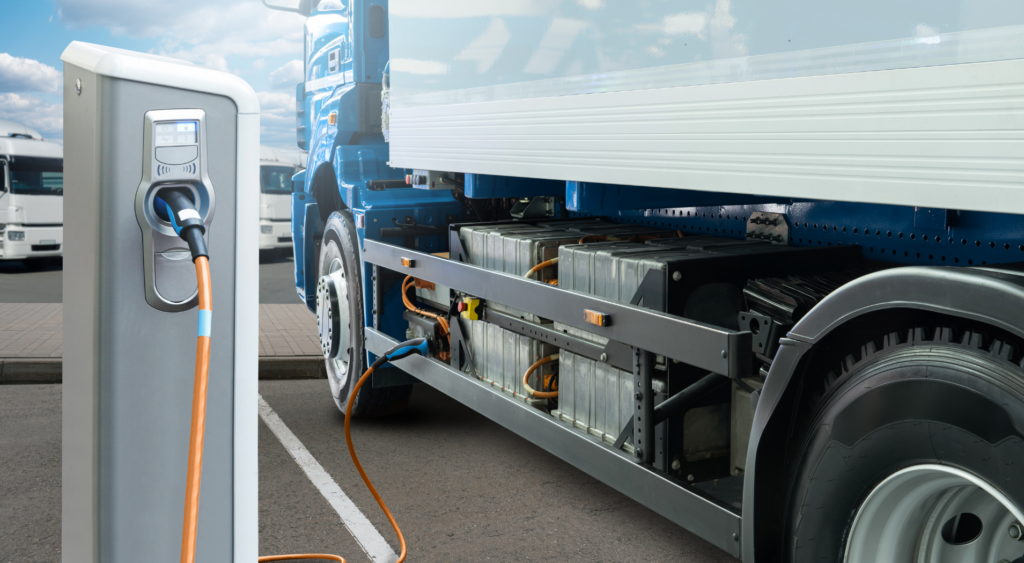
India now has over 29,000 public EV charging stations. But as the network grows, a more important question is emerging: are these chargers reliable and being set up in the right places?
Today, average utilisation across public EV charging stations in India is below 10%. To understand why, it helps to look at how public charging infrastructure evolved. Early EV policies, such as FAME I laid the foundation for India’s EV ecosystem by incentivizing early adoption of 2W, 3W, and 4W EVs, while FAME II scaled up dramatically, supporting over 16 lakh EVs, prioritizing buses and public charging infrastructure. Together, they mark the transition from pilot-stage adoption to systemic market creation. But a key behavioural reality was underestimated. Unlike petrol or diesel, private EV owners predominantly charge at home. Public chargers, for this segment, are largely reserved for weekends, long trips, or emergencies. The result was predictable: a large share of public charging infrastructure saw limited daily utilisation. A charger installed at a low-traffic location sits idle most of the day. It generates little revenue for the operator and does little to build driver confidence in EVs.
The next phase of India’s EV evolution must move beyond charger installation counts. It should focus on utilization ensuring chargers are placed where vehicles actually dwell and return.
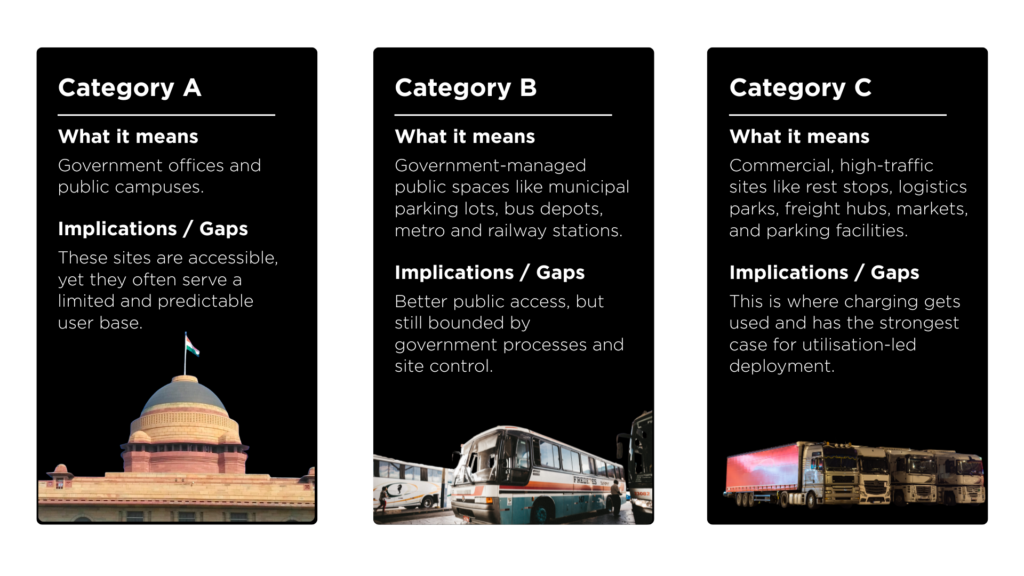
PM E-Drive Scheme Categories
The policy environment has evolved, The challenge is no longer a lack of policy intent, but a gap in implementation. PM E-DRIVE, the central government’s flagship scheme for subsidising EV public charging infrastructure, organises charging locations into three categories — A, B, and C, each mapped to different types of sites and land ownership.
Strengthening Category C Deployment under the PM E-DRIVE scheme for EV Public Charging Stations
The real utilisation opportunity lies in Category C — highway rest stops, logistics parks, freight aggregation hubs, market complexes, and commercial parking facilities. These are the places where fleet vehicles park overnight, delivery trucks wait between runs, and intercity and interstate operations take place. Charging infrastructure here does not sit idle. It earns. To genuinely shift toward utilisation-led deployment Category C deserves special attention. It covers the widest range of commercially viable, high-traffic sites, offers the strongest leverage for private investment, and is the furthest behind in execution.

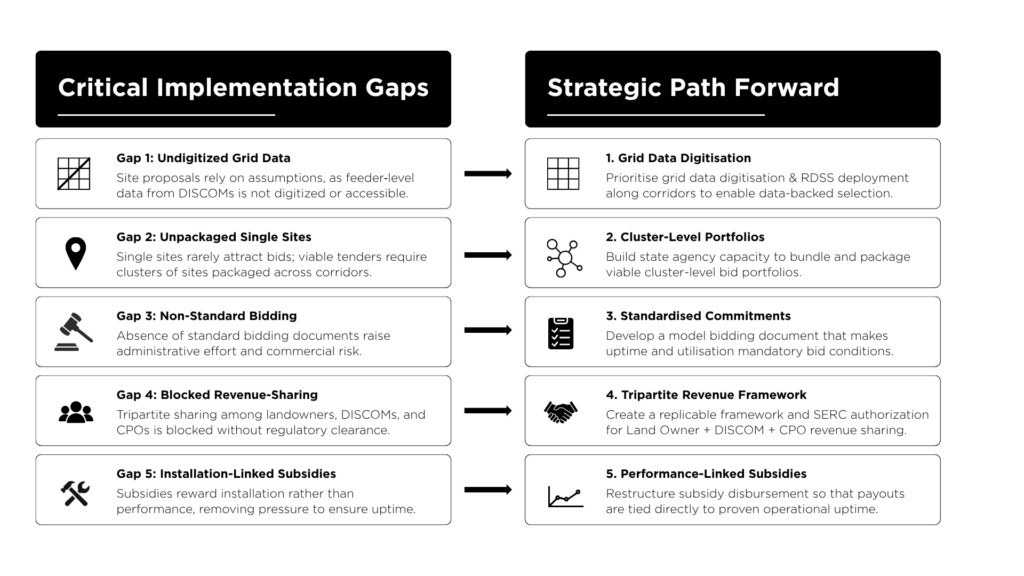
Implementation Gaps and the Path Forward
Despite being situated in areas of consistently high traffic and commercial activity, Category C locations under the PM E‑DRIVE scheme continue to underperform. This is not because the model is flawed, but because of persistent execution gaps. Based on consultations with ecosystem players and state-level agencies, Sattva Consulting has developed a five-point, interconnected solution to unlock Category C’s potential.
Where the Money Needs to Go
PM E-DRIVE carries an overall outlay of ₹2,000 crore for EV charging infrastructure. Of this, approximately ₹503 crore has been sanctioned predominantly for Categories A and B. Category C, the segment with the highest commercial potential and the strongest utilisation case, remains significantly underfunded and underdeployed.
Earmarking a defined portion of remaining funds for Category C and ensuring deployment is utilisation-led rather than coverage-led would make PM E-DRIVE a success in delivering assets with higher returns. India needs the right public chargers, in the right places, operating reliably for the drivers who need them the most.
Sattva has collaborated with various industry specialists across Charge Point Operators, Shippers, Logistics Service Providers, Fleet Aggregators, Battery Experts to produce a comprehensive technical paper detailing these findings; it can be accessed at this link. We are eager to engage in further collaboration and invite your feedback. Please contact sayak.ray@sattva.co.in or kevin.abraham@sattva.co.in to connect with our team.
Strengthening Category C Deployment under the PM E-DRIVE scheme for EV Public Charging Stations