
India’s IT industry, with total revenues of USD 283 billion in FY25, is one of the country’s most globally integrated sectors. Firms are facing rising pressure to demonstrate ESG performance and supply chain accountability owing to their exposure to global clients who are in turn increasingly subject to sustainability and disclosure mandates. While some firms have built credible governance systems and sustainability capabilities, many mid-tier companies still lack the internal readiness to respond to rapidly evolving expectations.
ESG Maturity Remains Uneven Across the Sector
A few of India’s leading IT firms have demonstrated that sustainability can be integrated into core business operations and aligned with ESG standards. Here are a few noteworthy milestones.
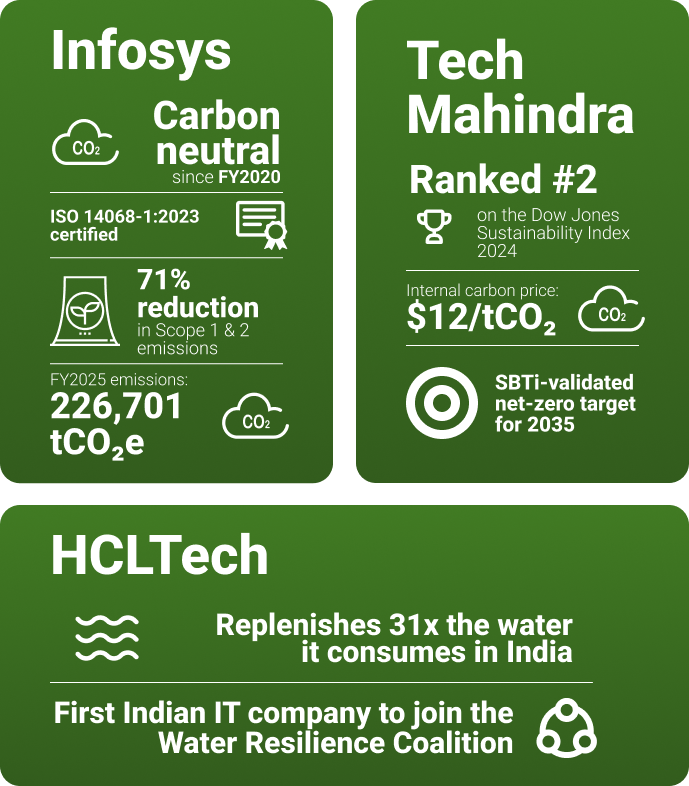
Though these developments signal meaningful progress, they do not entirely reflect ESG maturity of the sector as a whole. Many mid-tier firms are still building the internal systems, technical expertise, and operational ownership needed to effectively respond to evolving sustainability expectations.
Sector-level indicators further highlight this uneven progress. While India’s IT sector excels in the ‘social pillar’ of ESG, with an average female workforce participation rate of 34%, BRSR disclosures indicate that IT firms invest significantly less in environmental CapEx and R&D than manufacturing companies.

Hence, sector-wide ESG scores (averaging 75 for the IT sector) are disproportionately influenced by a few top-tier companies, masking capability gaps across mid-tier firms. These gaps are likely to become more consequential as regulatory and client expectations intensify and projected data-centre expansion of 8-10 GW by 2030 increases the sector’s energy and water footprint, thereby requiring stronger ESG management and reporting capabilities.
The Capability Bottleneck in Mid-Tier Firms
The divide between India’s largest IT firms and the mid-tier firms is not primarily one of ambition or capital. It is a capability gap rooted in the ability to understand ESG requirements, translate them into operational responsibilities, and build the systems needed to measure, manage, and track progress.
Most ESG frameworks operate on the premise that organisations can measure Scope 1 and Scope 2 emissions, track energy, water, and waste data, and engage meaningfully with materiality and governance accountability. However, many mid-tier IT firms are still in the process of building these foundational capabilities. Since the sector historically faced limited regulatory and market pressures around ESG, many firms continue to lack dedicated sustainability teams, cross-functional ownership, and the data systems required for assurance-grade reporting.
This capability gap is also recognised within the industry. In its 2024 Sustainability Playbook, NASSCOM outlined a phased sustainability maturity pathway covering leadership, integration, measurement, and communication. The framework highlighted a growing recognition that moving beyond disclosure-led ESG towards operational integration requires sustained investment in internal capabilities across functions.
Regulatory Horizons and Client-Led Market Expectations
What makes this capability gap critical is the intensifying external pressures emerging from two directions.
The first is regulatory. SEBI’s BRSR Core framework, a rigorous subset of 49 KPIs spanning intensity of GHG emissions, renewable energy share, water use, and gender diversity, now applies to the top 500 listed companies from FY2025–26 and will extend to the top 1,000 by FY2026–27. For many mid-tier IT firms, this may mark their first substantive encounter with mandatory sustainability disclosure. Meeting emerging disclosure requirements requires firms to have robust data systems, governance structures, and operational ownership in place to support credible reporting. While some organisations have already established these foundations, many others are still in the process of building and institutionalising them.
The second is client-driven, and more immediate. Europe contributes to one-third of the revenues of major Indian IT firms, translating to a sector-wide exposure of ~20-30% of total revenue. A major share of these clients are governed by the EU’s Corporate Sustainability Reporting Directive (CSRD), which mandates disclosure of Scope 3 emissions, including those embedded in outsourced services. Hence, Indian IT operations increasingly sit within the sustainability reporting of European enterprises, regardless of whether vendors are directly engaged in the process.
A 2024 Verdantix survey found that 47% of companies have offered preferential contracting terms to suppliers based on decarbonisation performance, and 64% now include sustainability metrics in supplier scorecards, up from 38% in 2020. At the same time, platforms such as EcoVadis and CDP Supply Chain are getting embedded in procurement workflows, becoming part of supplier evaluation processes. For instance, Infosys alone engaged 273 suppliers through CDP’s Supply Chain program in FY 2025.
The implication is straightforward: ESG is becoming a deal qualifier. Firms unable to credibly demonstrate carbon, water, and workforce metrics may not face immediate exclusion, but risk being deprioritised in procurement decisions that are difficult to reverse.
Digital Ambition and Resource Constraints
Alongside regulatory and procurement pressures, the sector is also confronting a challenge tied to the growth of data centres and AI adoption, coupled with an increasing amount of e-waste.
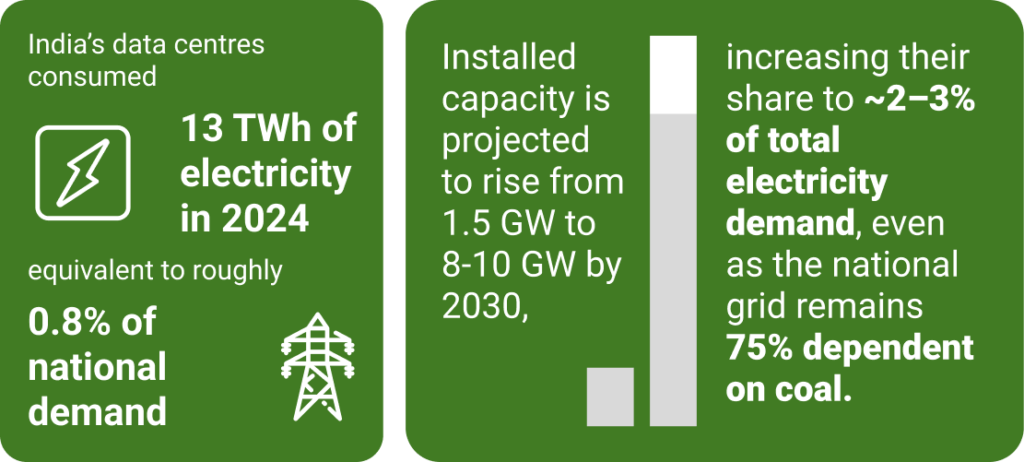
Cooling servers and computing infrastructure alone account for ~40% of data center energy consumption. Water stress compounds the challenge. Indian data centers consumed an estimated 150 billion liters of water annually in 2024, a figure projected to more than double by 2030. More than 60% of existing data centres are expected to face high water stress this decade. This is particularly relevant for data-centre hubs such as Maharashtra, Tamil Nadu, Telangana, Delhi-NCR, and West Bengal, where growing digital infrastructure is increasing the pressure on water resources.
Beyond water use, AI adoption is also driving a sharp increase in energy demand. A single AI query can consume up to ten times the energy of a standard web search, raising the possibility that rapid infrastructure growth could offset emissions reductions achieved elsewhere. Yet regulatory frameworks for reporting AI-specific energy and water consumption remain nascent.
E-waste adds another layer of complexity. India generated ~6.19 million metric tonnes of e-waste in 2024, with computer equipment accounting for the largest share of this waste stream. However, ~90% continues to be managed by the informal sector, which often lacks advanced recovery capabilities. Rapid hardware obsolescence, particularly of AI accelerators such as GPUs, combined with limited domestic capacity to recover critical minerals, is creating a growing environmental and supply-chain challenge.
The Shift from ESG Reporting to Operational Capability
The path forward for India’s IT sector will depend less on announcing more ambitious ESG targets and more on strengthening the operational capability required to execute them. Three priorities particularly stand out.
1. Scope 3 reporting must move from voluntary to operational
Only 51% of India’s top 100 listed companies disclosed Scope 3 data for FY2023, with inconsistent methodologies across disclosures. Research published in Nature Communications suggests that corporate reporting may omit up to half of total value-chain emissions. For IT firms, Scope 3 encompasses categories such as purchased goods and services, business travel, employee commuting, and cloud infrastructure-related emissions.
2. Diversity reporting needs to mature
Women account for 34% of India’s IT-BPM workforce, exceeding the global average of 28.2%.

Despite strong workforce representation, women remain underrepresented in leadership roles, accounting for only 14% of Key Managerial Personnel and ~18.7% of board positions.

McKinsey’s 2025 India study shows that female representation declines by 2 percentage points at each successive level of hierarchy, beyond middle management. While India’s 2015 mandatory quota improved board diversity, C-suite representation has remained largely stagnant at 15-18%, with over half of listed firms still reporting no women in top management as of 2023. Despite this, few companies link diversity outcomes to executive pay. The pattern reflects a broader ESG gap: disclosure has advanced faster than the systems needed to interpret data and drive accountability. Firms have the capability to report ESG metrics, but many still lack the ability to translate them into sustained organisational change.
3. Building internal ESG capabilities is critical
While regulatory disclosures are often managed by sustainability or compliance teams, ESG performance is shaped by decisions made across core business functions such as procurement, operations, HR, and finance. As a result, firms need to move beyond compliance-led approaches and integrate ESG considerations into day-to-day decisions. This requires sustained investment in capabilities such as cross-functional awareness, governance mechanisms, and practical ESG knowledge.
From ESG Commitments to ESG Capability
India’s IT sector has made significant progress on ESG disclosures and workforce diversity. However, as ESG expectations grow more operationally complex, competitive advantage will increasingly depend on an organisation’s ability to generate reliable data, manage emerging risks, and embed ESG considerations into everyday decision-making.
Many firms continue to face challenges related to fragmented data systems, limited ownership beyond sustainability teams, inconsistent supplier engagement, and uneven ESG capabilities across business functions. As regulatory scrutiny, client expectations, and operational risks intensify, these capability gaps are likely to become increasingly consequential.
Addressing them will require a fundamental shift; from viewing ESG as a reporting requirement to treating it as a core organisational capability. Investments in governance, data architecture, supplier engagement, and cross-functional ownership will be critical to translating ESG commitments into measurable business outcomes.
The firms best positioned for the future will not only be those with the most ambitious ESG targets, but those that build the capabilities needed to measure, manage, and deliver them at scale.
All views expressed are personal and do not necessarily represent those of the organisation.
If you are navigating the shift from ESG compliance to capability-building, we would be glad to engage at esg@sattva.co.in.