

Introduction
For decades, corporate philanthropy has largely been understood through a Western institutional framework in which social spending remains voluntary, discretionary, and primarily shaped by corporate priorities rather than formal developmental obligation. Across much of the Global South, however, a different institutional logic is emerging.
As the G20 presidency cycled through this triad (2023–2025), a “Southern Doctrine” became codified. It is a model born of necessity, designed to address entrenched inequality and infrastructure gaps that Western frameworks often overlook. For the multinational corporation (MNC), IBSA offers a laboratory for Fiduciary Purpose: a move away from segmented, national compliance towards a holistic global mission. For policymakers, these regimes represent a vital mechanism to unlock private capital for development in an era where foreign aid is in structural decline. This is no longer about “giving back”; it is about the strategic integration of private capital into the public good.
Three types of Corporate Social Responsibility
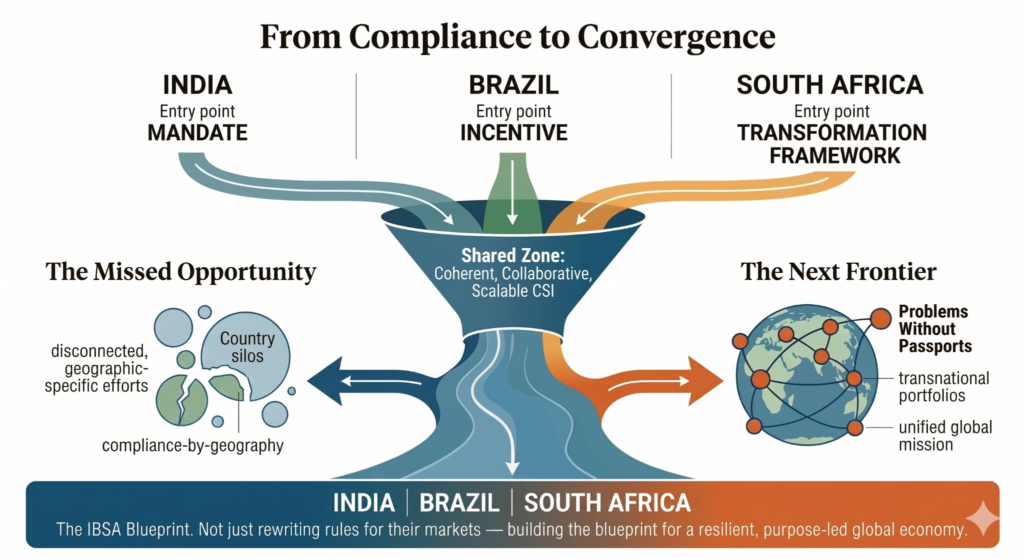
India, Brazil, and South Africa confront comparable development conditions marked by persistent inequality, uneven infrastructure, and large informal economies, but the institutional architectures through which CSI evolved in each country differ significantly. Their present-day systems reflect distinct political choices: statutory obligation in India, incentive-based voluntary investment in Brazil, and transformation-linked integration in South Africa.
How CSR works in India
In 2013, India made corporate social responsibility mandatory. Under the Companies Act, qualifying firms are required to spend at least 2% of their average net profits on CSR activities aligned with national development priorities.
The scale of capital mobilised since then has been substantial. Indian companies spent about USD 1.43 billion on CSR in 2014, and by 2019 that figure had grown by 85 per cent to USD 2.67 billion. According to CSR’s Next Act Report 2025 by Sattva Consulting, the total annual CSR outlay has now reached nearly USD 3.25 billion. In the initial years, firms were still adapting to the regulatory architecture, and investment deployment remained relatively fragmented, with funds distributed across unrelated initiatives primarily to satisfy statutory obligations. The movement of capital was therefore institutionally driven, but strategically uneven.
Over time, however, the quality of deployment has evolved significantly. While board oversight was embedded in the original legal framework, corporate engagement with CSR has become increasingly strategic. Governance mechanisms have moved beyond procedural compliance towards stronger oversight of programme design, execution, and outcomes. Independent impact assessments are now mandatory for large projects.
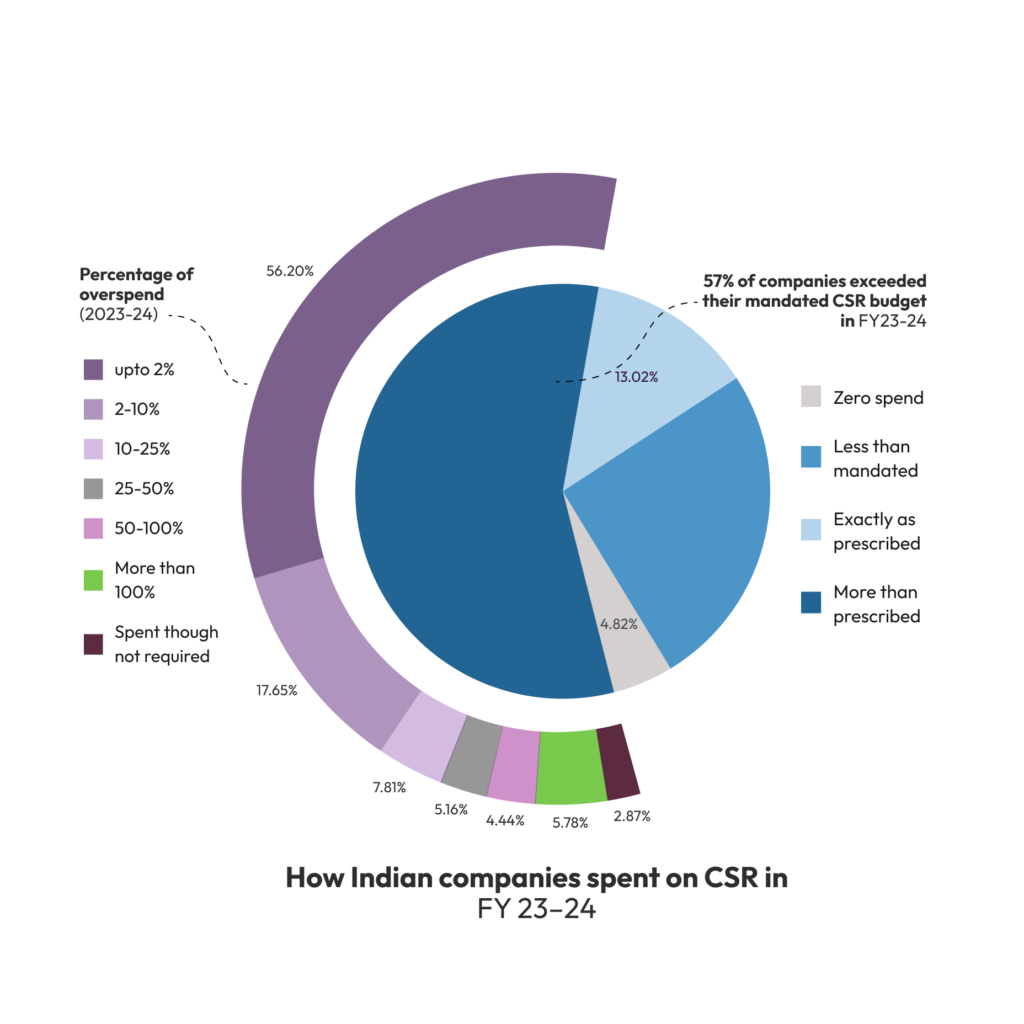
More than 56% of qualifying companies exceed their prescribed expenditure, and over half of CSR investments are directed toward sectors linked to firms’ core business domains. India has consequently developed one of the world’s most data-intensive corporate giving ecosystems, not solely because firms embraced transparency, but because the regulatory framework progressively made measurement, disclosure, and accountability unavoidable.
Does Brazil Have Mandatory CSR Spending?
Brazil’s tradition of philanthropy has deep historical roots, shaped by religious giving, family foundations, and long-standing forms of private-sector social engagement. The 1988 Constitution and its social rights structure marked a turning point in the evolution of philanthropy. While public expenditure constraints limited the state’s condition to deliver social welfare fully, the private sector and civil society assumed a complementary developmental role.
During the 1990s, economic liberalisation helped professionalise this landscape, transforming dispersed philanthropy into Private Social Investment (PSI): the voluntary, planned, and monitored allocation of private resources toward public-interest initiatives. Unlike India, Brazil did not adopt a mandatory spending framework; instead, it developed an incentive-based model anchored in tax benefits for investments in culture, sports, and social protection. This enabled alignment with public priorities while preserving strategic flexibility.
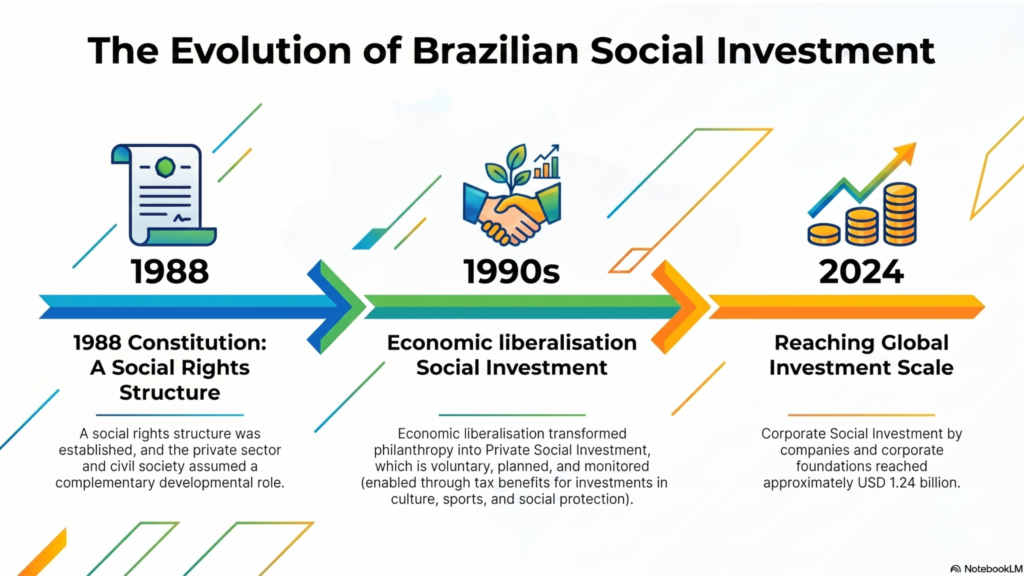
This flexibility has enabled Brazilian Corporate Social Investment (CSI) to act as a force multiplier for public problem-solving. According to the Brazilian Benchmarking of Corporate Social Investment (BISC), CSI contributions by companies and their corporate foundations reached BRL 6.2 billion in 2024 (approximately USD 1.24 billion). Furthermore, companies are increasingly focusing on strengthening civil society and local communities by supporting initiatives in areas such as education, workforce development, climate resilience and state capacity.
What Is the Purpose of BBBEE in South Africa?
Prior to 1994, corporate giving in South Africa was largely reactive, shaped by the social inequalities produced under apartheid and channelled primarily through corporate foundations and trusts. These interventions were often driven by moral obligation and reputational considerations rather than by a clearly articulated strategic development framework.
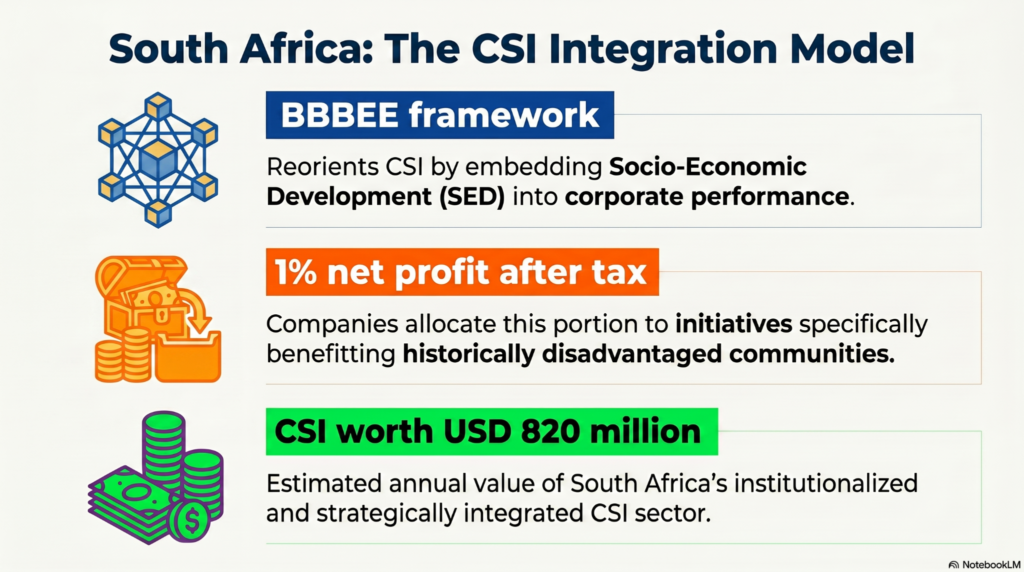
Following the democratic transition, the introduction of the Broad-Based Black Economic Empowerment (BBBEE) framework reoriented CSI by embedding Socio-Economic Development (SED) within corporate performance metrics. Under this framework, companies are strongly encouraged to allocate 1% of net profit after tax toward initiatives benefiting historically disadvantaged communities, thereby linking social expenditure more directly to broader transformation objectives.
Over time, South African CSI has evolved into a more institutionalised and strategically integrated system. Estimated at approximately USD 820 million annually, the sector has progressively shifted from reactive grant-making toward programmes aligned with core business operations, sustainability priorities, and the Sustainable Development Goals. Increasingly, the emphasis is on interventions designed for systemic impact, with greater attention to long-term partnerships, collective outcomes, and structural inclusion.
Models of Corporate Social Responsibility
Each country has developed a distinct CSI architecture over time. While no single model is sufficient in itself, taken together they offer a more comprehensive framework for companies than any one national approach in isolation.
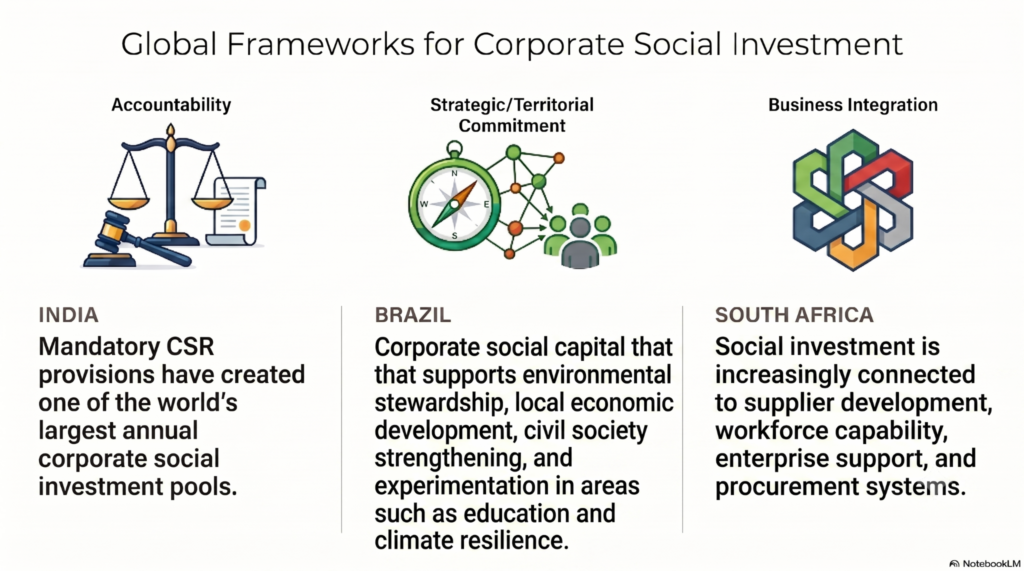
India’s accountability model is anchored in the combination of scale, predictability, and disclosure. Mandatory CSR provisions have created one of the world’s largest annual corporate social investment pools, generating a consistent corpus of development capital that exceeds USD 3 billion each year. Mandatory reporting requirements, independent impact assessments, and increasingly sophisticated digital monitoring systems have consequently introduced a degree of rigour more commonly associated with capital allocation than with philanthropic expenditure, strengthening firms’ ability to assess effectiveness, compare outcomes, and improve the strategic quality of social investments over time.
Brazil’s strategic model combines place-based investment, thematic focus and strategic flexibility. Companies invest in the development of material communities, territories and social causes, while aligning social investment with broader society priorities. This enables corporate social capital to implement different ways to generate positive impact, supporting environmental stewardship, local economic development, civil society strengthening, and experimentation in areas such as education and climate resilience, often through frameworks designed to sustain impact beyond individual projects.
South Africa’s integration model links CSI closely to core business functions. Social investment is increasingly connected to supplier development, workforce capability, enterprise support, and procurement systems, reflecting an approach in which communities are positioned as participants within broader economic value chains rather than passive beneficiaries of corporate expenditure.
Taken together, these approaches represent three distinct but complementary levers: accountability, strategic and territorial commitment, and integration with business operations. Their convergence suggests a more complete framework for CSI, one that is increasingly relevant for emerging markets beyond the India-Brazil-South Africa context.
International lessons on Corporate Social Investment Strategy
The central lesson across India, Brazil, and South Africa is that institutional design can mobilise capital, but capital alone does not produce development outcomes. Whether resources are generated through statutory obligation, fiscal incentives, or transformation-linked frameworks, their effectiveness ultimately depends on the surrounding ecosystem: capable implementing organisations, credible measurement systems, and a pipeline of programmes able to absorb sustained investment at scale. Without these conditions, even well-funded commitments risk producing fragmented outcomes rather than durable change.
It is at this point that all three systems increasingly converge. India’s experience demonstrates that regulation can create discipline, but also reveals the limits of expenditure without absorptive capacity. Brazil’s model shows that voluntary systems can generate strategic alignment, but require strong intermediary institutions to maintain continuity and depth. South Africa’s evolution illustrates that integration with business strategy improves durability, but also depends on collaboration beyond the firm itself.
What increasingly distinguishes contemporary CSI is no longer whether spending is mandatory, but whether capital is deployed coherently, collaboratively, and at a scale capable of addressing systemic challenges. Across countries, firms are progressively shifting from isolated projects toward portfolios designed to link local interventions with longer-term development outcomes.
For multinational corporations, this raises a strategic question: whether to continue managing social investment country by country, shaped primarily by local regulation, or to articulate a unified global social mission that adapts to national contexts while retaining strategic coherence across geographies. The latter approach is more demanding, but it also allows firms to transfer knowledge, institutional partnerships, and operational learning across markets.
This is particularly important because many of the challenges CSI seeks to address do not conform to national boundaries. The next frontier for CSI lies increasingly in moving from country-specific compliance toward transnational development strategies capable of responding to what practitioners increasingly describe as “problems without passports.” The immediate challenge for the modern CEO is to move beyond compliance-by-geography. Managing CSI as a fragmented, territorial obligation is a missed opportunity for scale.
Simultaneously, for Global South policymakers, IBSA offers a proven toolkit to bridge the funding gap left by dwindling international aid. By professionalizing the social investment ecosystem, through audited impact and systemic integration, nations can transform corporate mandates into a sustainable engine for equitable growth. The IBSA triad is not just rewriting the rules for their own markets; they are providing the blueprint for a resilient, purpose-led global economy.
Conclusion
The IBSA countries have arrived, through different institutional pathways, at a broadly similar conclusion: CSI performs most effectively when it is strategic, measurable, and closely connected to how firms understand their long-term role within society.
The volume of capital matters less than the institutional quality through which it is deployed: whether investments address clearly defined problems, whether credible systems exist to assess outcomes, and whether firms remain sufficiently invested in the results to sustain engagement over time.
The G20 rotation across India, Brazil, and South Africa between 2023 and 2025 may have been coincidental in sequence, but it placed three of the most developed corporate social investment ecosystems in the Global South into an unusually close comparative view. The institutional lessons emerging from that moment are likely to remain relevant well beyond the IBSA context.