What does it take to build a nonprofit partnership that can sustain impact over the long term? How can funders make grantmaking processes work better for the organisations delivering that impact on the ground?
Over 80% of the money flowing into Indian philanthropy now comes from domestic sources, and the sector has never had so much capital to deploy. In this landscape, CSR has emerged as a unique force that can drive and reshape India’s development journey. At Sattva, we have had the privilege of working with both sides of the ecosystem: corporates that deploy the money and nonprofits that translate it into impact. Both sides are ambitious in their own ways, and each faces its own tensions.
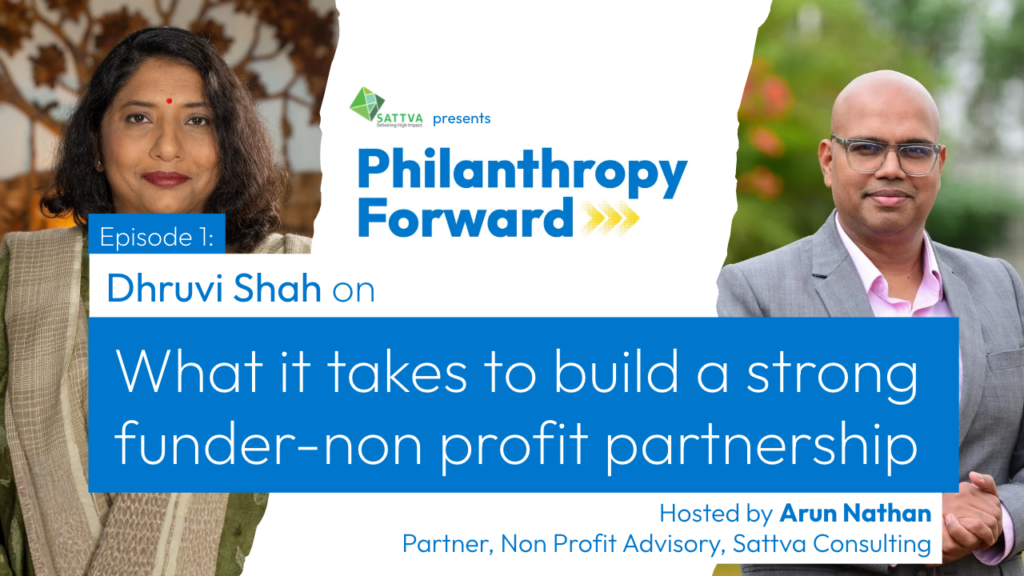
Philanthropy Forward, our new dialogue series, brings those two sides into the same conversation. It explores the practices, choices and questions shaping the future of philanthropy. In the first conversation, Arun Nathan, Partner, Non-profit Advisory at Sattva, speaks with Dhruvi Shah, Executive Trustee at Axis Bank Foundation, about the realities of CSR grantmaking and funder–nonprofit partnerships.
Drawing on Axis Bank Foundation’s experience, the conversation looks beyond the mechanics of funding to examine what makes a partnership work in practice. The Sustainable Living Programme under ABF has been active close to two decades now and Dhruvi reflects on how its approach to grantmaking and rural livelihoods has evolved over time while the programme’s name stayed intact.
The dialogue kicks off with a deceptively simple question: what makes an organisation a strong partner for a funder? Philanthropy Forward debuts as an essential masterclass for organisations when they reach out to funders.
Dhruvi Shah explains that ABF looks well beyond documents. She shares what the foundation notices on the ground, including one field visit moment that says a great deal about an organisation, and the early signs that make ABF hesitate. It also opens up an interesting idea about what a funder’s “no” means. In this case, Dhruvi shares that a “no” from ABF does not necessarily signal poor work, and some conversations have continued for as long as five years before ABF funded the organisation.
In other cases, the partnership has lasted decades but that doesn’t guarantee an automatic renewal. It is also a constant process of building a relationship in which both the programme and the institution behind it can grow, while continuing to review progress and priorities.
“If an organisation does not have a capacity-building budget, it raises questions about whether it is evolving, growing and forward-looking.” – Dhruvi Shah
The conversation also touched upon contested parts of grantmaking: overheads, capacity building and the cost of delivering impact. It became clear that money is not the only thing that decides how much good a project does. Funders and nonprofits often disagree on how much of a grant should go towards running costs and building skills. Dhruvi calls capacity building “the highest form of impact we can achieve”. She describes impact and capacity as two sides of the same coin, which is why funders need to fund capacity as part of the impact budget.
But at the same time if an organisation is asking for a capacity budget but cannot explain what the capacity is for, that raises questions around accountability.
The final part of the conversation brings these ideas down to the operational level. What happens when funding arrives late? Salaries may not get paid, procurement may be pushed back, and time-sensitive interventions can miss their window throwing off an entire impact cycle. Here, grant management becomes a question of impact itself, requiring funders and nonprofits to understand and adapt their systems together.
Across the conversation, Arun and Dhruvi keep returning to a larger idea: lasting impact depends on partnerships that both sides keep building, questioning and refining over time.
That idea shapes the advice Arun leaves with both sides of the table. Nonprofit leaders are urged to change how they show up in a funder conversation, from what they lead with to the mindset they bring. CSR practitioners and committees are asked to rethink what they measure, where they invest and how quickly money moves once a decision is made. What each of them can do differently, and how Arun and Dhruvi’s discussion leads to it, is best heard in the conversation itself.
Watch the first episode of Philanthropy Forward on YouTube for the full conversation on long-term partnerships, nonprofit capacity, overheads and the practices that can make CSR grantmaking work better for impact.