

In the face of falling Official Development Assistance, and persisting social challenges, Africa is in need of a new paradigm of development funding: one that is more domestic, self-sustaining, and catalytic. Data shows that as of 2025, ODA fell by 23.1% globally, the largest annual decline on record. On the other hand, climate change, political conflicts, uneven access to healthcare systems, and growing youth populations demand long-term investment which can remain flexible in case of emergencies. Companies, with their financial resources, operational expertise, and understanding of the local ecosystem, could fill the gap through Corporate Social Investment (CSI), complementing government spending. India’s decade-plus CSR journey has shown the true potential of corporate philanthropy – with a corpus of USD 4.7 billion collected in just FY2024-25.

Our new report, The State of Corporate Social Investment in Africa, analyses the top 30 companies by revenue in three countries – Zambia, Kenya, and South Africa. It lays out the landscape of CSI, examining the levels of participation, sustainability reporting, thematic priorities, and paths ahead for each country. The report also offers a peek into the impact playbook of 10 companies.
Zambia, Kenya, and South Africa: A spectrum of maturing CSI ecosystems
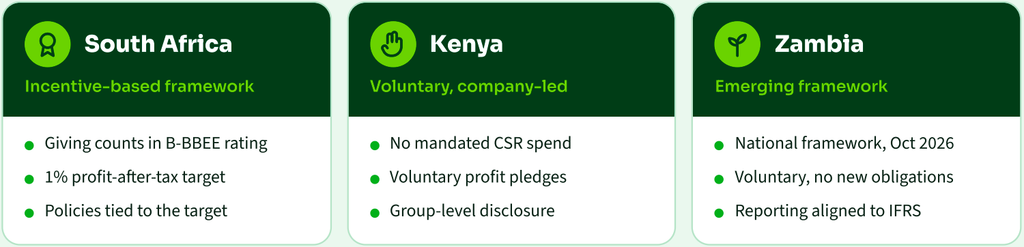
The three countries sit on a spectrum of CSI maturity. Zambia’s early-stage CSI landscape is dominated by copper mining firms. There is a lack of clarity on what CSI constitutes, and inconsistency in reporting, which will hopefully be resolved through the country’s new National CSR Guidelines Framework and IFRS S1 & S2 coming into effect next year.
Of the 30 companies sampled in Kenya, 97% engage in CSI. Large companies voluntarily pledge to donate profits, and strong collaborations with global foundations and DFIs enable impact. The next step is to make programme delivery more systemic.
The Broad-Based Black Economic Empowerment policy in South Africa incentivises socioeconomic development funding. This is the most mature ecosystem of the lot, with companies often integrating giving into their policies and having full-fledged CSI departments.
Key insights from research
Responsibility and opportunity: Even without a formal CSI mandate, African corporates recognise their responsibility to stakeholders (customers, employees, host communities and home countries) and the business opportunities a strong corporate citizenship agenda can unlock.
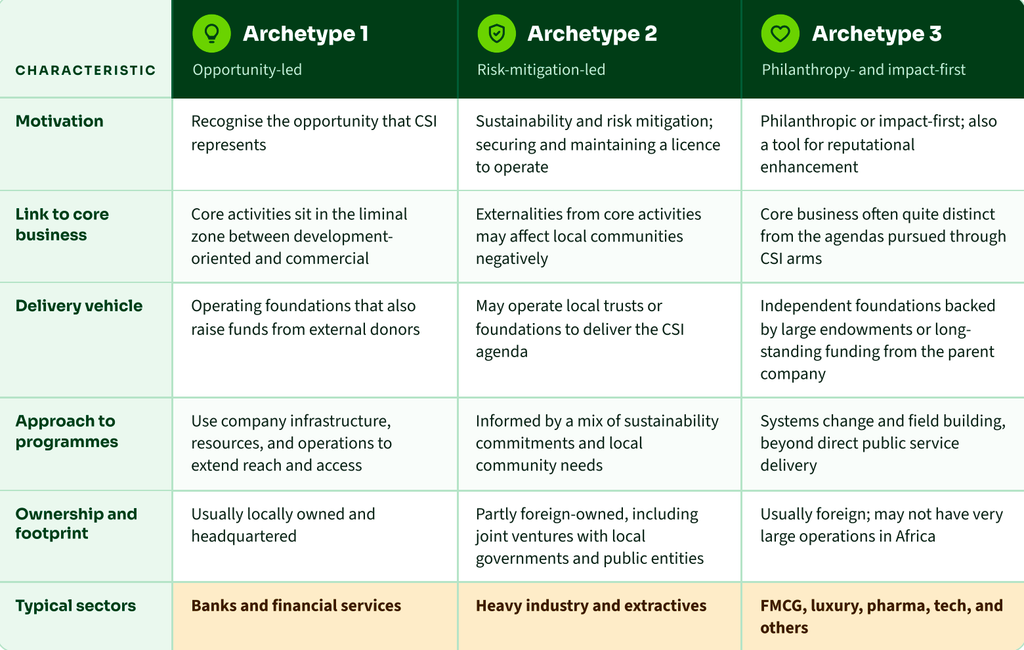
Three broad CSI archetypes: Companies fall broadly into three groups. Opportunity-led firms, usually locally owned banks and financial services, use their infrastructure to extend reach and access. Risk-mitigation-led firms, typically heavy industry and extractives, give to secure a licence to operate. Philanthropy- and impact-first firms, usually foreign-owned FMCG, luxury, pharma and tech, fund independent foundations focused on systems change. Some companies’ involvement is limited, with little strategic intent yet.
Reporting remains patchy: There is little consensus on what counts as CSI or how to report it. Upcoming sustainability reporting standards will help, but national or regional frameworks are needed for consistency.
Partnership at the core: Collaboration already sits at the heart of African CSI, with corporates working with governments, international organisations, and local NGOs. Corporate-to-corporate partnerships and industry associations can do more to unlock it at scale.
Volunteering is growing: Most companies still run simple time-volunteering programmes, while a few leaders offer skills-based volunteering and matched giving. Applying corporate expertise to public service delivery is a key way to magnify CSI’s impact.
The bottom line
Africa needs an estimated USD 194 billion till 2030 to meet the Sustainable Development Goals, as per OECD. Corporate philanthropy could become an important partner of governmental spending and other sources of aid to close this gap. Our report captures country-specific analyses along with a glimpse into the impact playbooks of 10 corporates making their mark in Africa.
There are reasons to be optimistic about the potential of CSI in Africa, and with enough focus on better reporting, stronger partnerships, and more strategic and outcome-focused interventions, companies can become a catalytic force for impact on the continent.