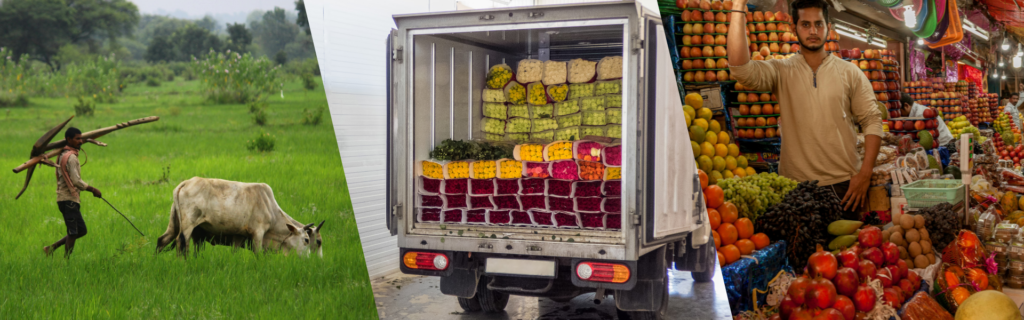
Imagine a mid-sized FMCG firm filing its FY25 report: 4,000+ smallholder suppliers, batch records ending at aggregators, and Scope 3 data based on estimates. Its European cumin exports face strict border testing. In the years ahead, these issues become simultaneous disclosure liabilities under three distinct regulatory frameworks all pointing to the same underlying gap – limited upstream supply-chain visibility and data.
This traceability gap begins at the farm gate due to systemic constraints. Land governance in Indian smallholder farming is largely informal. Unregistered leases, undocumented shared rights, and seasonal sharecropping can create blind spots when identifying and tracking actual suppliers. A single GPS coordinate can confirm if a farm exists at a particular location; but it cannot establish who owns the land, has legal rights to it or whether the person supplying the produce has secure rights to cultivate it.
Polygon mapping, which captures the full boundaries of a plot, provides greater visibility into overlapping, fragmented or adjacent plots. However, even detailed boundary mapping cannot verify leases, shared-use agreements or sharecropping arrangements that may exist only in the form of verbal agreements between families. Furthermore, regular updates to this involve high costs, leaving geographic data outdated.
Above the farm gate, multi-tiered aggregators blend the produce into single lots before reaching processors. Paper tracking and manual logs often lead to lost farm identity before materials enter formal supply chains, making it costly and difficult to reconstruct the tr\ail for audits. Closing that gap needs field-level verification through FPOs/FPCs, local field staff, or community-anchored institutions, layered on top of geospatial data, not a substitute for it. Thus, there exist multiple institutional, legal, and supply chain related challenges, and geospatial tools alone cannot alone resolve them.
The Regulatory Shift: From Disclosure to Evidence
Evolving food-safety and ESG requirements are raising the bar for traceability and data quality. FSSAI’s Labelling and Display (First Amendment) Regulations, notified in March 2026 and effective July 2027, mandates batch-level identification and stricter front-of-pack labelling, alongside Front-of-Pack Nutrition Labelling for HFSS products and a digitised Food Safety Compliance System (FoSCoS). As a result, organisations are facing greater expectations to substantiate claims on ingredient origin, nutritional content, sourcing and batch traceability.
These developments point to a broader shift: compliance is moving from declaration to evidence. This shift also reflects in the value-chain requirements under BRSR Core, for SEBI-regulated companies. Since the 2025 revision, the top 250 listed companies are required to assess ESG performance across upstream and downstream partners that individually account for 2% or more of purchases or sales by value, subject to a 75% coverage cap.
For agri-intensive FMCG and processing companies, the 2% threshold places the focus on their largest aggregators, mills and FPOs; often at the very point at which farm-level identity is lost. A company may therefore meet BRSR Core’s value-chain requirements, while still having little visibility into the smallholders, who actually produced the crop. Closing this gap requires traceability to extend beyond tier-1 suppliers to the farm level.
Export markets add another layer of commercial risk. Between January 2024 and April 2025, the US FDA refused ~2,687 India-origin food shipment line items, including ~320 spices and flavourings, largely due to Salmonella and pesticide-residue violations. Indian cumin has also faced enhanced EU border scrutiny since 2023, with inspection frequency rising to 30% from January 2025 following repeated pesticide-residue detections.
The EU Deforestation Regulation raises the bar further, requiring companies placing cattle, cocoa, coffee, oil palm, rubber, soy or wood on the EU market to establish a link between the product and the plot of land where it was produced. For exporters, this means that if origin cannot be evidenced at the point of testing, inspection or audit, the consequence is no longer a compliance gap, it can translate into rejected shipments, higher border scrutiny and lost market access.
The Economics of Traceability: Why Delays Cost More Than Action
Traceability isn’t just a compliance or reporting exercise; it is a business capability that enables organisations to identify, anticipate and mitigate supply-chain risks before they translate into losses.
It creates value in four areas:
- Quality & food safety
Traceability helps organisations isolate affected batches rather than recall entire product lines. Without traceability, if a batch fails chemical residue, food-safety or quality testing, it forces a full product-line recall, because there’s no way to isolate the affected portion. With farm-to-batch traceability, the same failure narrows to a specific batch and often a specific aggregator cluster, thereby cutting recall volume, write-offs and reputational exposure sharply.
- Yield & Quality Optimisation
Farm-level data around cultivation practice, input use, micro-climate, soil type allows a company to attribute yield or quality variance to a specific driver instead of averaging it away across a region. Farm-level traceability enables organisations to segment suppliers by key performance drivers using data collected over two to three crop seasons. This allows them to target agronomic support where it can deliver the greatest impact, rather than spreading resources uniformly across the supplier base.
- Precise Input Advisories
The same farm-level data, particularly KPIs such as % of soil organic carbon and fertilizer-use records, when used effectively, turns generic advisory into targeted advisory. For eg, which farms need SOC intervention, which are over-applying nitrogen, which are ready for a variety change. Businesses can pair every round of data collection with a feedback loop back to the farmer or FPO.
- Procurement integrity
Farm-level traceability lets a company reconcile declared farm size and expected yield against delivered volume, thereby surfacing side-selling and the blending of lower-grade market produce into premium or export-bound streams before it becomes a downstream compliance failure. Companies should build volume reconciliation into the procurement workflow itself, flagging deliveries that exceed a farm’s plausible output at the point of intake itself.
A decision businesses need to make is determining where identity-preserved traceability, and mass-balance traceability is necessary. Identity-preserved traceability keeps produce from a specific farm or cluster physically separate throughout the supply chain, allowing the final product to be traced back to its source. Mass-balance allows produce to be pooled, while tracking verified inputs and reconciling them against outputs by volume.
Identity-preserved offers the strongest assurance and is best suited for high-risk, high-value or export-bound segments (EUDR-covered commodities, premium-certified lines). Mass-balance is more feasible at scale across fragmented, mandi-based sourcing. While mass-balance is sufficient for administrative sustainability reporting, food-safety and MRL compliance strictly require physical batch segregation. Applying identity-preservation everywhere is rarely viable; relying on mass-balance everywhere can leave the high-risk segments exposed.
It is important to note that both these models rely on the same farm-level data infrastructure. Once an organisation can link a batch to its source, it can also identify yield drivers, target agronomic support, and detect leakage. Therefore, organisations need to view traceability as shared infrastructure that creates value across compliance, risk, quality, and productivity rather than as a tool for addressing individual requirements.
When organisations can identify where and why a problem occurs, they can:
strengthen supply-chain resilience
protect market access
improve business credibility
target interventions more precisely and enhance their effectiveness
How to Embed Traceability into Procurement and Field Processes
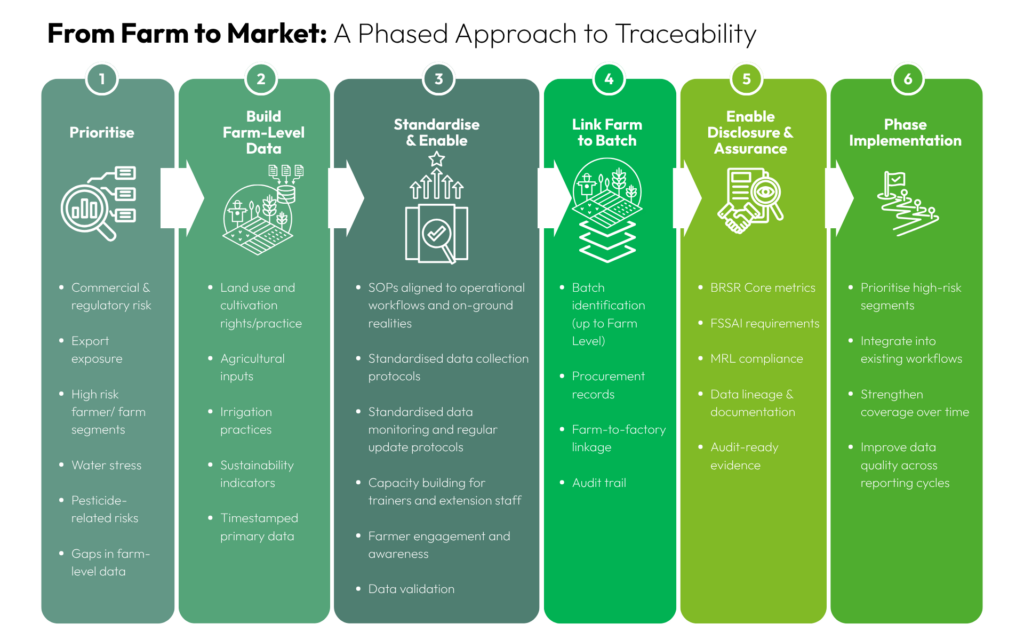
Building credible traceability is an incremental process. Organisations can start with the highest-priority supplier segments and expand coverage as data quality, systems and implementation capabilities improve.
The first priority needs to be on building traceability into existing procurement and field processes, particularly where smallholders/plantations, mandis, aggregators and multiple intermediaries are involved, rather than creating parallel systems.
- Transactional Integration:Embedding digital identifiers at weighing scales or payment points enables continuous data capture with minimal additional effort from field teams. For example, Olam’s Farmer Information System uses one-time farm registrations to link subsequent purchases and advisory interactions to individual farmer records.
- Institutional Partnerships: Engaging FPOs, primary cooperatives, and local field NGOs allows businesses to validate land and farmer data without incurring unsustainable field-audit overheads. For example, Mondelez’s Cocoa Life works through existing cooperative structures to engage farmers at scale.
- Intermediary Modernization: Upgrading procurement hub workflows bridges multi-tier intermediary gaps, turning operational intake logs into an auditable traceability trail. For example, ITC’s e-Choupal integrated digital information and procurement processes at the village level, improving visibility and streamlining procurement.
Technology alone cannot close the aggregator gap. SOPs need to reflect on-ground realities and be supported by capacity building for trainers and extension staff. The goal for companies therefore, is to ensure data is reliable and usable for reporting, assurance and business decisions. Integrating traceability into existing workflows, supported by clear documentation and data lineage, can help turn operational data into credible evidence for regulators, auditors and customers.
All views expressed are personal and do not necessarily represent those of the organisation.
Footer: Looking to improve farm-level traceability and supply-chain visibility? Write to us at esg@sattva.co.in to explore how data can strengthen compliance, resilience and market access.