Takeaways
• Maharashtra, Gujarat, and Karnataka received the highest CSR funds in absolute terms in FY2024-25.
• Andaman & Nicobar, Jammu & Kashmir, and Jharkhand have grown fastest, though from small bases.
• States with high poverty still receive a low share of CSR. Bridging this gap is vital to meeting development needs.
• Home-state loyalty, growing preference for tier 2 cities, and place-based CSR are shaping where companies invest in
• CSR’s local area preference is a directive, not a law.
CSR grew 14% in FY2024-25 to Rs. 40,794 crore, but the increase is not evenly distributed across the country. As companies begin investing their tech, talent, and networks along with capital, understanding state-wise CSR spending becomes foundational to tracking social progress, identifying need gaps, and spotlighting opportunities for corporates.
How do we track regional CSR fund allocation?
The distribution of CSR across the country is understood from project location data shared by companies. Over the last decade, the precision of this reporting has improved remarkably. In FY2014-15, 46% of all projects were tagged ‘Pan-India.’ In FY2024-25, this fell to just 4%.
Better reporting gives a clearer view of state-wise and district-wise CSR investments, and of what each area needs.
Which states receive the highest CSR funds in India?
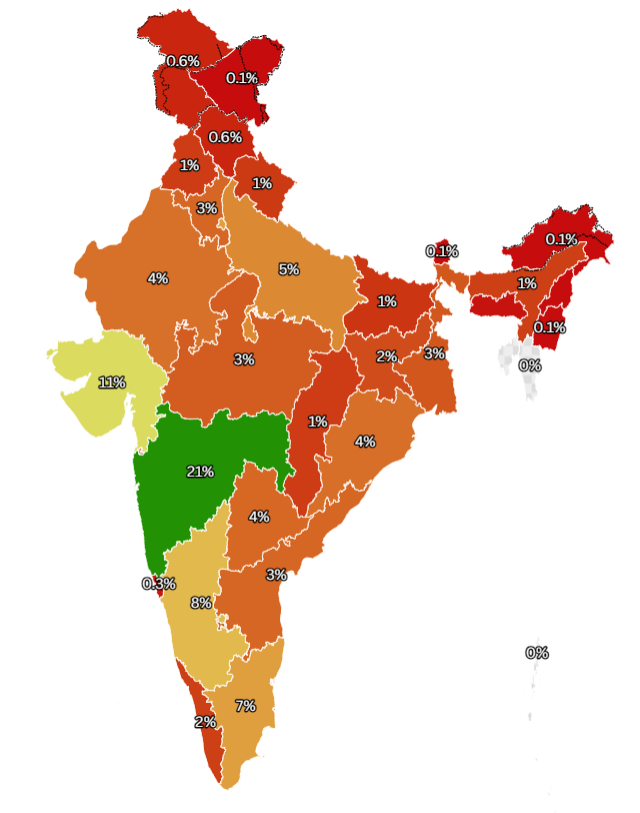
In FY2024-25, Maharashtra received the most funds, capturing 21% of the year’s total, or approximately Rs. 8,566 crore. Gujarat and Karnataka followed with 11% (Rs. 4,487 crore) and 8% (Rs. 3,263 crore) respectively. These states also saw the highest increase in spend by absolute value.
Does state-wise CSR spending in India align with needs?
Our newly released annual CSR report says, not as much as it should. States with higher poverty still receive a lower share of CSR.
Maharashtra, for example, has a Multidimensional Poverty Index (MPI) of 0.033 and received 21% of the year’s corporate philanthropy. Bihar and Jharkhand, with the highest MPI scores of 0.16 and 0.131, received only 1% and 2%. The trend holds as we zoom in: 70% of FY2024-25’s CSR went to districts with low MPI, and only 10% to districts with high MPI.
Corporates are increasing their contributions to high-need regions, albeit doing it alongside investments in urban areas rather than replacing it. Underfunded states like Andaman & Nicobar saw a 398.7% uptick in CSR between FY2023-24 and FY2024-25. Mizoram’s investments increased by 233.3%.
What’s critical is for this percentage growth to translate more concretely into absolute funding and for corporates to commit to funding high-need regions as a key lever for India’s overall development.
What are the trends behind state-wise CSR data?
Our previous CSR reports, CSR’s Next Act and Why 60% of Manufacturing CSR stays in Plant Districts, capture some key patterns behind company’s spending decisions.
Company size and home-state loyalty
As per CSR’s Next Act, more than 40% of CSR is deployed in the state where a company is headquartered. The tendency is strongest among smaller firms. In FY24, 47% of companies with CSR budgets under Rs. 1 crore spent only in their home state, and 58% of their allocations went to projects in that region. These firms also sent nearly half (45%) of their spending to Tier-1 cities and clusters. Firms with budgets above Rs. 10 crore spread more widely, though about a third of their CSR still went to home states.
This likely reflects footprint: smaller firms operate locally, while larger ones work across multiple locations. It also means that states hosting many headquarters, such as Maharashtra, Karnataka, and Gujarat, gain structurally.
Tier-2 cities are the new growth engines
Cities with over a million people raised their share from 13.5% to 16.2% between FY22 and FY24, and inflows to cities of 1-2 million nearly doubled. Vadodara, Varanasi, Mysuru, and Madurai stood out for their multifold growth in CSR funds in FY24.
Manufacturing companies invest heavily in ‘plant’ districts
Among projects of manufacturing companies that disclose their districts, 57% of CSR spending occurred in districts where companies operate manufacturing facilities. Nearly 92% of manufacturing companies maintain some level of CSR investment in their manufacturing or ‘plant’ districts. For extraction-heavy businesses, locally-concentrated CSR is a way to give back, taking responsibility for their environmental footprint and maintaining community trust.
CSR spending in East and North-East India
Rich in minerals and brimming with industries, Eastern India is emerging as an attractive hub for Corporate Social Responsibility, particularly districts like Jharsuguda in Odisha and Raigarh in Chhattisgarh. Jharsuguda alone received over Rs 549 crore in 2023-24, primarily from sectors such as metals, energy, and mining.
When it comes to the North East, states received only a fraction of CSR in FY2024-25. Assam attracted 1%, while Manipur, Sikkim, Arunachal Pradesh, Nagaland, and Meghalaya received only 0.1%.
Mizoram’s and Meghalaya’s growth in FY25 is heartening, but Manipur and Arunachal Pradesh have seen investments decline over the years. There could be a few reasons CSR is yet to turn its attention to the North East: including the home-state affinity, logistical challenges in finding implementation partners and executing programmes in remote areas, and the overall reluctance of corporate philanthropy to invest in environmental sustainability, livelihoods, gender, which are key development areas of the NE.
How does the CSR local area preference rule influence spending?
Section 135(5) of the Companies Act, 2013 states that a company “shall give preference to the local area and areas around it where it operates” for spending its CSR funds.
However, with the rise of e-commerce, process-outsourcing, and aggregator companies, the MCA has clarified that as long as CSR projects align with national priorities and the Sustainable Development Goals, local area preference is a directive, not mandatory. In practice, much of the regional skew above comes from the preference being followed: companies fund where their plants, offices, and headquarters sit. Freed from strict local preference, companies with no physical footprint can direct funds to high-need geographies.
The takeaway
CSR still concentrates in a handful of large states, cities, and industrial belts, but the picture is gradually broadening. Reporting is more precise, Tier-2 cities and industrial districts are growing fast, and funding is beginning to reach high-poverty states and districts. For funders, the clearest opportunity lies in high-need geographies, where the need is greatest and the room to make a difference is largest. Geographic spread alone is not enough. The next step is aligning where CSR goes with where development gaps are widest.