
CSR has acquired a formidable collection of things over the years.
Spreadsheets. Dashboards. Partner reports. Baseline studies. Impact assessments. Due-diligence checklists. Board presentations. And, somewhere in a shared drive, a file called Final_CSR_Dashboard_v7_FINAL2.xlsx.
This is not a criticism. Much of the last decade of CSR has been about becoming more systematic: better data, clearer processes, stronger governance and more rigorous measurement. The digital transformation of CSR was necessary.
But digitisation created a new problem. We now have much more information than we have attention.
And this is where artificial intelligence becomes interesting.
Not because AI can write a passable paragraph about education or livelihoods. Not because every CSR programme needs a chatbot. And certainly not because a large language model should be deciding which nonprofit gets funded.
AI matters because it changes the relationship between people and information.
A spreadsheet can now answer questions. A hundred-page partner report can be interrogated rather than merely read. Thousands of rows of CSR data can become an exploratory conversation. A beneficiary survey can happen in her own language, over a phone call, without requiring an army of enumerators.
The next transformation of CSR may therefore be less about going digital and more about making the digital world we have already created considerably more intelligent.
AI is reducing the distance between questions and answers
Consider public CSR data.
India has something rather extraordinary: a large body of information about what companies spend on CSR, where they spend it and on what causes. But anyone who has worked with large government datasets knows that having data and being able to use data are not quite the same thing.
Traditionally, getting from raw data to an answer requires a chain of specialists.
Someone cleans the data. Someone writes a query. Someone builds the pivot table. Someone creates the dashboard. Someone interprets the dashboard. Finally, someone asks a question that the dashboard was not designed to answer.
Generative AI starts to shorten this chain because language itself is becoming an interface to data.
Imagine a CSR leader being able to ask:
Which districts in Karnataka receive relatively little education CSR funding despite poor learning indicators?
Or:
How has climate-related CSR spending changed over the last five years?
Or simply:
Who else is funding something similar to us, and where?
Behind the scenes, the work remains decidedly unmagical. Data needs to be cleaned, classified and structured. Questions need to be translated into analysis. Results need to be checked.
But the distance between having a question and getting a useful first answer shrinks dramatically.
This is already visible in Sattva’s own experimentation. One recent exercise used a combination of machine learning and AI to classify industries for thousands of companies in CSR datasets, with multiple validation approaches used rather than trusting a single AI answer. Making MCA data on tens of thousands of CSR-contributing companies easier to explore through conversational analysis is an important use-case.
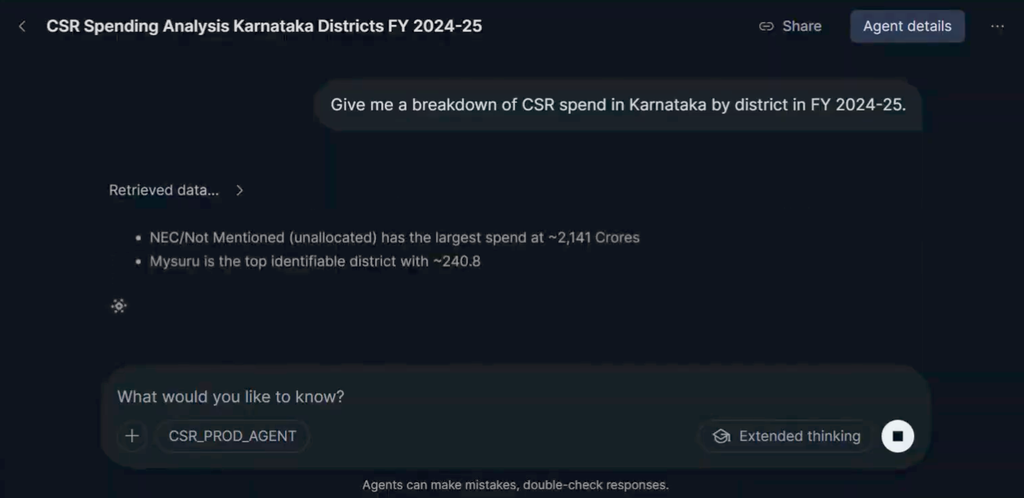
That distinction matters. The interesting future is not “AI made us a nicer dashboard.” It is “more people can now ask better questions of the underlying data.”
The glamorous AI use cases may not be the useful ones
When people imagine AI in CSR, the conversation often jumps to beneficiary-facing applications: a chatbot for farmers, an AI tutor, an automated helpline.
Some of those will be important. But a great deal of value may arrive wearing much duller clothes.
Take the everyday machinery of managing a CSR portfolio.
An implementation partner sends a proposal, a logical framework and a budget. A programme manager reviews them. Information is copied between templates. Inconsistencies are spotted. Questions go back to the partner. Revised versions arrive. Someone checks them again.
None of this will make the cover of Wired. It is also where thousands of hours disappear.
Within Sattva, teams have been experimenting with AI-assisted review of logical frameworks, and assisting in NGO due diligence. In one internal prototype, a process that could take roughly two hours was brought down substantially by automatically extracting information and flagging discrepancies for a human reviewer.
The important words there are for a human reviewer.
This is not a vision of autonomous CSR administration. It is closer to giving a competent programme manager a tireless first-pass analyst.
The machine reads everything, but the human decides what matters.
That pattern can repeat across portfolio management: synthesising partner reports, checking reporting completeness, comparing programme designs, analysing budgets, finding evidence relevant to a proposed intervention, or identifying recurring risks across a portfolio.
The phone call is making an unlikely comeback
Then there is voice AI.
For years, “digital” largely meant getting people to use a screen. That is not necessarily an elegant solution in a country with enormous variation in language, literacy, connectivity and digital confidence.
AI creates a rather different possibility: perhaps the interface does not need to be an app at all. Perhaps it is a conversation.
Voice AI systems can now conduct structured calls, understand spoken responses and operate across Indian languages. This opens up interesting possibilities for monitoring, evaluation and learning.
Imagine a skilling programme with 20,000 participants. Instead of conducting a large beneficiary study twice a year, a programme could speak to a smaller rotating sample every month. Ask what has changed. Understand why somebody dropped out. Detect recurring complaints. Identify a centre that seems to be struggling.
Not everything needs to become a survey either. Voice could support follow-ups, grievance collection, reminders, programme navigation or qualitative feedback.
This changes the economics of listening.
Historically, organisations have had to make a trade-off between depth, frequency and scale. Rich conversations are expensive. Large surveys are episodic. Frequent monitoring tends to become structured and shallow.
Voice AI does not eliminate those trade-offs, but it moves them. And that raises a more provocative possibility.
Sattva has tested Voice AI in more than 1000 community conversations, across multiple impact assessments, monitoring and verification exercises. Completion rates have ranged from 10% to 65%, but what the exercise has proven are the distinct advantages of faster data collection, programme level outcome deployment, multilingual deployment.
But the biggest impact of AI on monitoring and evaluation goes well beyond impact assessments. And this can happen if we stop treating listening as something that happens mainly during an impact assessment.
There is, unfortunately, a catch
Actually, there are several. AI is extremely good at sounding as though it knows what it is talking about.
While this can be charming when asking for restaurant suggestions, it is less so when deciding whether evidence supports a ₹5 crore programme.
AI systems hallucinate. They can misinterpret documents. They reproduce biases hidden in their training data. They can perform differently across languages and populations. Sensitive information entered into inappropriate systems can create serious privacy risks.
CSR adds another layer of responsibility because much of the underlying data concerns people who have considerably less power than the institutions collecting information about them.
A voice system speaking to an adolescent girl is not merely a productivity tool. A model analysing disability data is not merely a clever spreadsheet. A system recommending which communities to prioritise is making choices close to questions of fairness and exclusion.
So the appropriate principle is not human in the loop as a ceremonial checkbox.
It is something stronger: the consequence of the decision should determine the strength of human oversight.
Let AI classify 50,000 rows of data? Certainly — provided you test the classification.
Let it summarise thirty partner reports? Useful — but link every important conclusion back to the source.
Let it flag anomalies in a budget? Excellent.
Let it decide whether a nonprofit is trustworthy, whether a programme works, or whether a community deserves investment?
No. Speed is not judgement.
So where should a CSR leader begin?
Probably not with an “AI strategy”.
Start with irritation.
Find the work that makes good people wonder why they are spending their lives doing it. The report that is manually assembled every quarter. The dataset everyone possesses but nobody explores. The due-diligence process that involves opening nineteen tabs. The beneficiary feedback that arrives six months too late. The valuable knowledge hidden inside 400 project folders.
Then ask a more useful question than “Where can we use AI?”
Ask: “What can we now do that was previously too slow, too expensive or simply too difficult?”
That framing tends to produce much better ideas.
The practical sequence is fairly unexciting — which is usually a good sign.
Get the data foundations right. Choose a bounded problem. Establish what a good answer looks like. Test AI against human work. Put privacy and access controls in place. Keep humans accountable for consequential decisions. Measure whether anything actually improved.
Then scale what works.
From digital records to institutional intelligence
The first wave of CSR digitisation helped organisations capture more of what they were doing. AI could help them understand more of what they have captured.
That is a subtle distinction, but potentially a much bigger transformation.
CSR comes with some hard problems: knowing where capital can create the most value, understanding what programmes are actually telling us, listening properly to communities, identifying problems early, and carrying learning from one intervention into the next.
AI can change the economics of solving these problems. And perhaps that is the useful way to think about AI in CSR.
Not as an oracle, or as an autopilot. And definitely not as the person who signs off the grant.
More like a new layer between our questions and the enormous amount of information we already possess.
The CSR spreadsheet has learned to talk. The important question now is whether we know what to ask it.