Takeaways
- CSR has matured. Over the last decade, CSR spending in India has moved from a legal mandate to a catalyst for corporates to take responsibility and contribute beyond capital.
- Shared value is the goal. The strongest CSR aligns with a company’s core material issues, the social and environmental topics most relevant to its industry.
- Education and Healthcare lead. In FY25, Education drew 34% and Healthcare 21% of total CSR funding, consistent with recent years.
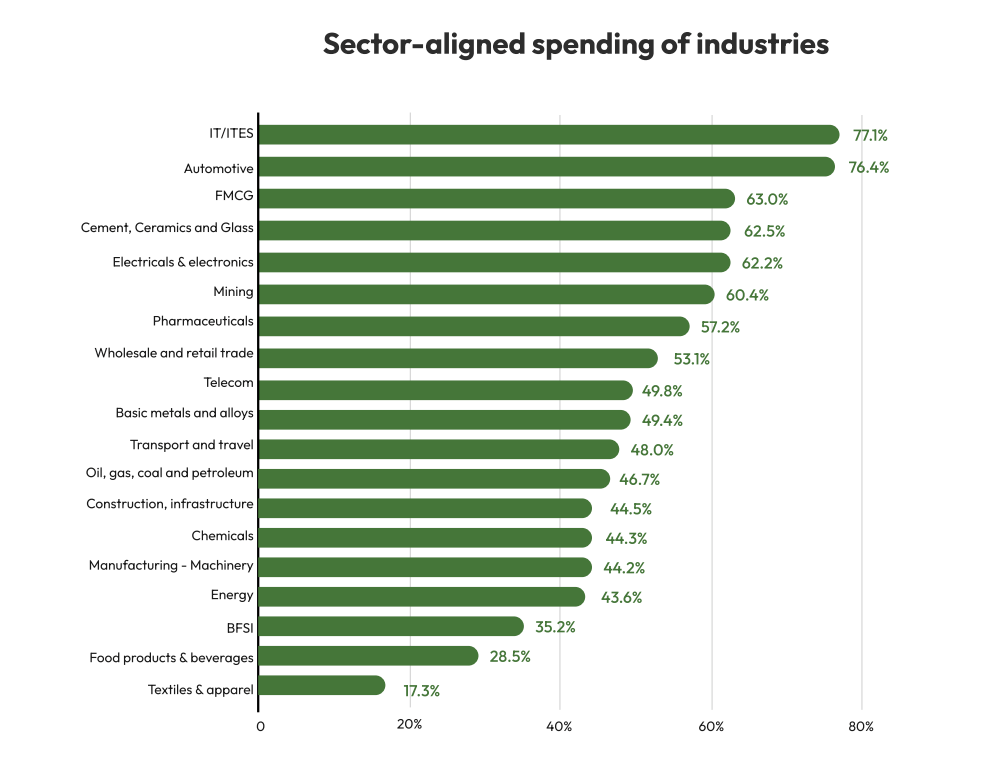
- Material alignment is uneven. As of FY24, IT/ITES (77.1%) and automotive (76.4%) lead, while BFSI, food products and textiles tie fewer than one-third of projects to their most relevant issues.
- Corporates can be co-creators. Beyond grants, companies can contribute operational capability, patient capital and risk capital, and help design solutions rather than only fund them
Over the last decade, CSR spending in India has bloomed from a legal mandate into something far more pivotal: a catalyst for firms to recognise, take responsibility, and reimagine what they can contribute to society.
As we’ve always believed, Impact is Everybody’s Business, and we are starting to see it unfold in corporate philanthropy: firms backing social challenges that align with business needs, leveraging technical expertise, committing to longer-term projects, empowering their CSR teams, and exploring contributions beyond capital.
Creating shared value: where business relevance meets social needs
At its most catalytic, CSR can create shared value for business and society, if corporates are willing to draw on their own expertise and network to address a societal need. Certain companies are already doing this, aligning their CSR with core material issues (meaning the social and environmental topics most relevant to their industry) and using that alignment in three ways:
• Advancing national development priorities. By focusing on societal issues relevant to their industry, companies can move the needle where they have the most to offer.
• Strengthening their social licence to operate. Addressing issues that matter to stakeholders across the business value chain, or in the geographies where the business is important, builds trust and resilience.
• Complementing sustainability targets. Integrating CSR with ESG strategy means social investments and sustainability goals reinforce each other instead of running in parallel.
Top CSR sectors in India: do thematic priorities vary by industry?
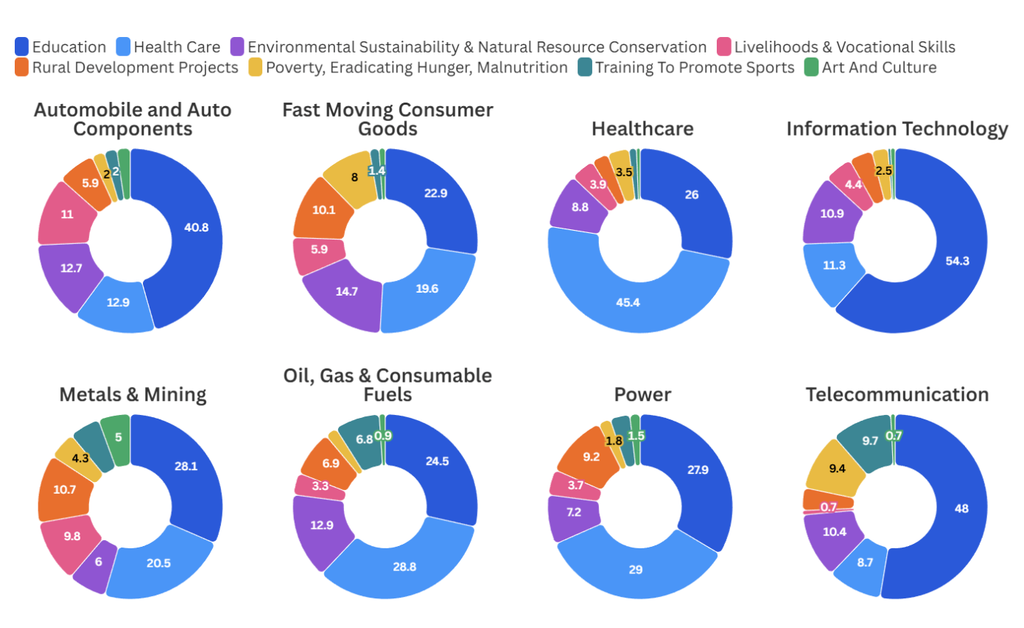
If shared value and business materiality are influencing a company’s approach to CSR, how much of this perspective shift is reflected in sector-based funding? Well, as consistent with the last few years, Education and Healthcare remained the top-earning sectors in FY25, with Education attracting 34% and Healthcare 21% of total funding.
Most industries mimic this pattern, but what varies is the the percentage they dedicate to each sector, and the other sectors they contribute to.
Source: Sattva Consulting and India Data Insights
Information Technology, for example, gave more than 50% of its budget to Education. Automobiles and Metals & Mining give slightly heavier emphasis to livelihoods and vocational skills.
This ties into findings from CSR’s Next Act, on material alignment of industry needs with CSR investments. As of FY24, IT/ITES (77.1%) and automotive (76.4%) are the clear leaders in this alignment. At the other end, BFSI, food products and textiles have fewer than one-third of their projects tied to the issues most relevant to their business.
Source: CSR’s Next Act: How the Coming Decade Will Redefine Corporate Impact, Sattva Consulting
Part of the gap comes from where CSR money already flows. Industries whose material needs include health and education, such as IT, tend to score higher, because most CSR funding goes to those two areas anyway. Other industries often default to the same popular causes, even when their own priorities lie elsewhere.
This points to a clear opportunity for sector-specific guidance that helps industries redirect their spending to where it is most relevant and effective. For instance, BFSI companies could prioritise rural development over generic healthcare programmes.
Material alignment is also influenced by CSR budgets. Companies with larger budgets have greater flexibility to create a CSR portfolio that is diverse enough to address multiple industry priorities. On the other hand, smaller budgets necessitate more focused allocations, often prioritising company-specific issues over broader industry themes.
Beyond grant-making: Corporates as co-creators of solutions
Creating shared values extends beyond giving grants alone. Corporates can become system co-creators by shifting from funding programmes that others design to helping design the solutions themselves.
That means contributing operational capability to coordinate many actors, patient capital that stays committed, and risk capital that absorbs the uncertainty markets cannot yet price and governments may not yet be ready to underwrite.
Another key shift is the understanding of success in impact, extending beyond programme completion to whether evidence generated, capabilities created, and strong collaborations forged can be embedded into larger systems for impact at scale.
Ultimately, as companies continue to strive for shared value for CSR, they may just step up as model citizens of our society, helping us address India’s deepest structural challenges, and transforming the nation for good.
Our annual CSR report for 2026 explores India’s development gaps and where companies must focus to create much-needed long-term impact. Check it out.