India’s manufacturing sector is at an inflection point.
Manufacturing today contributes 16-17% of India’s GDP and has seen sustained year-on-year growth of 8.4%, with high-momentum sectors such as Auto (33.5%), Metals (12.7%), Pharmaceuticals (10.2%), and Mining (6.8%) driving expansion. The Union Budget 2026-27 increased capital expenditure by 11.5%, reinforcing the government’s infrastructure push. Additionally, policy initiatives such as Semiconductor Mission 2.0 and Biopharma SHAKTI further signal ambition to position the country as a global manufacturing hub.
Yet, beneath this growth narrative lies a structural tension. Though most large manufacturing corporations in India adhere to state and central labour laws and align with international frameworks such as ILO Conventions, CSRD, and Forced Labour Protocols (2014); significant labour-related risks persist across value chains. These risks do not remain confined to compliance checklists, but increasingly influence business perception, operational continuity, cost structures, and long-term growth.
Compliance Without Assurance
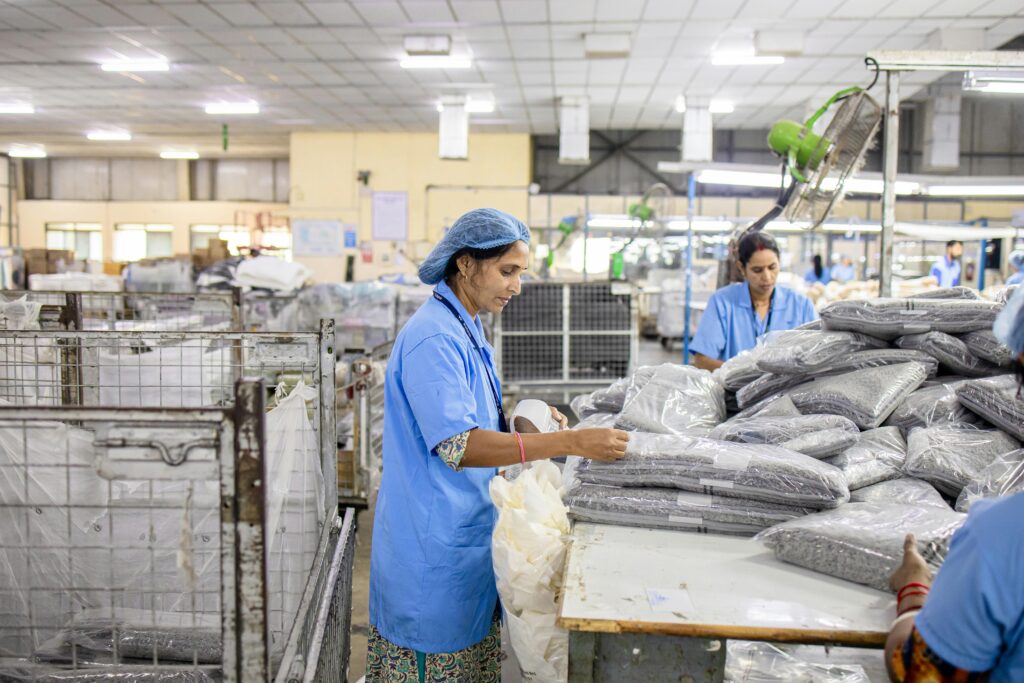
Popular imagination still frames manufacturing through the lens of early industrialisation — repetitive tasks, rigid supervision, and limited worker agency. While automation, digitisation, and smart manufacturing have transformed many factory floors in Modern Times, elements of that era persist particularly in lower-tier supplier networks where safety, dignity, and voice remain uneven.
Nowhere is this dual reality more visible than in India’s manufacturing sector. From Automobiles and Metals to Mining, Pharmaceuticals, and Textiles, the sector underpins economic growth through vast, globally integrated supply chains. While technological upgrades and stronger regulations have improved efficiency and workplace standards in many areas, some labour risks continue to remain insufficiently addressed.
In India, despite manufacturing GVA growth of 11.9% and employment growth of 5.9% (2023-24), enforcement of labour standards remains uneven due to varying state-level compliance systems, limited inspection capacity, and sector-specific vulnerabilities.
In high-impact sectors such as mining and heavy manufacturing, Occupational Health & Safety risks remain acute. Mining recorded the highest Lost Time Injury Frequency Rate (LTIFR) of 0.47 in FY2024. Workplace incidents across manufacturing, mining, and energy sectors in late 2024 resulted in over 400 fatalities. Reported non-fatal injuries are far more frequent, many of them disabling and affecting long-term worker mobility and productivity.
Gender inequity further compounds this structural risk. Although India’s female labour force participation rate rose to 41.7% in 2023-24, organised manufacturing employs only around 1.5 million women compared to 7 million men. The decline in women’s representation is further evident in core technical and leadership roles, reinforcing the well-documented ‘broken pipeline’.
Why This Is a Business Issue
Labour risks directly affect business performance. Manufacturing value chains with frequent worker issues see annual employee turnover rates of 28%—well above the global average of 18%. Replacing a frontline worker costs about 33% of their annual salary, making attrition an expensive problem.
The upside is equally clear. Gallup (2024) finds that companies with high employee engagement deliver 23% higher profitability. Deloitte India reports that smart manufacturing systems integrating safety monitoring can increase productivity by 10% and reduce costs by 12%.
In a world of real-time social media scrutiny and ESG-linked capital flows, labour violations can quickly escalate into reputational damage, investor caution, and share price volatility. Worker wellbeing is no longer just a social concern, it is increasingly linked to operational performance and financial outcomes.
From Risk Mitigation to Systemic Solutions
Encouragingly, some industry players are demonstrating that systemic constraints can be navigated with intentional design:
3M institutionalised structured respiratory protection programmes aligned with OSHA standards, integrating hazard assessment, fit testing, and medical evaluation. Such programmes are associated with 40-60% reductions in occupational respiratory disease in high-exposure industries.
Honeywell, through its ISO 45001-aligned HSEPS management system, has reduced recordable injury rates by over 80% since the early 2000s by embedding hazard identification, training, audits, and continuous improvement across global sites.
Unilever has trained over 4,000 Mental Health Champions under its “Healthier U” programme and provides 24/7 employee assistance access, normalising psychosocial safety, enabling early intervention, and reducing burnout and absenteeism risks.
TRL Krosaki addresses livelihood instability among contract workers through its “Utthan” programme, strengthening skills and income stability in high-risk industrial settings.
Similarly, Toyota Kirloskar Motor has strengthened shop-floor inclusion through structured DEI initiatives. In March 2024, it inducted 55 women supervisors and 160 female team members, raising its total women workforce to over 450, with an ambition of reaching 30%. By expanding women’s participation in technical and supervisory roles, it’s addressing labour risks while building a more capable and inclusive manufacturing workforce.
Together, these examples signal a broader shift: labour risk management is moving beyond compliance toward capability building, system redesign, and operational resilience.
The Way Forward
As manufacturing capital deepens and global scrutiny intensifies, large corporations with complex value chains will need to move from reactive compliance to proactive risk intelligence.
This typically involves:
- Systematic labour risk diagnostics across supplier tiers
- Integrated OHS, DEI, and wellbeing strategies
- Contract labour formalisation pathways
- Stronger grievance and monitoring systems
- Clear linkage between worker wellbeing and performance metrics
India’s manufacturing ambitions, from infrastructure expansion to advanced industrial policy, will ultimately rest not only on capital expenditure and technology adoption, but also on how effectively resilience, safety, and dignity are embedded within its value chains.
This is where structured, standards-aligned approaches can play an important role. Manufacturers are increasingly undertaking SA 8000 readiness assessments, embedding decent work principles into management systems, formalising contract labour practices, and strengthening grievance and safety architectures across supplier tiers.
Gender-intentional strategies are also helping expand women’s participation in technical and leadership roles, while also strengthening overall workforce capability.
Sattva Consulting supports enterprises in this transition, combining labour risk diagnostics, SA 8000 alignment, and gender-responsive value chain design to move organisations from reactive compliance to more credible, performance-linked approaches. Re-assessing labour risks today is not a regulatory exercise. It is increasingly being seen as a strategic investment in sustainable industrial growth. To explore how this can be embedded within your value chains, write to us at esg.sattva.co.in
This piece is authored by Shreya Verma, Engagement Manager, Sustainable Business Advisory. All views expressed are personal.